

What a medical EMC pre-compliance lab should provide
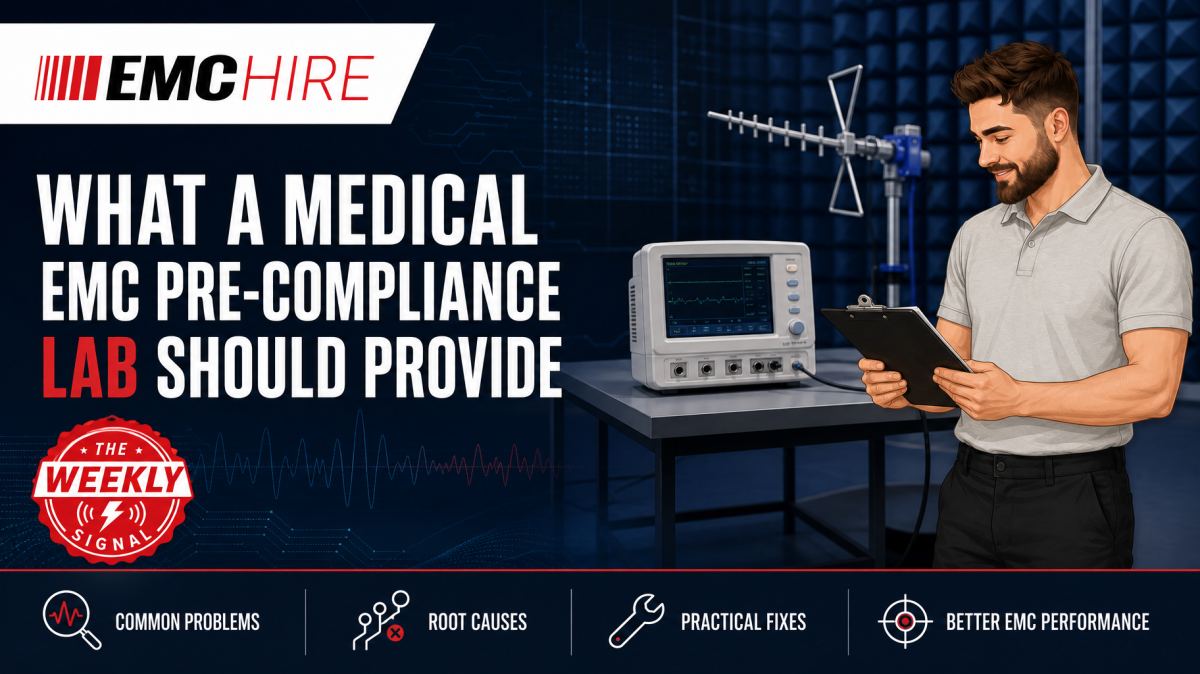
A medical EMC lab can own the right instruments and still deliver poor pre-compliance evidence if the support equipment, EUT configuration and test records are not controlled.
For procurement teams, the real question is not simply whether a provider can run tests. It is whether the facility can reproduce relevant medical electrical equipment conditions, identify weaknesses early and deliver data that engineering teams can use.
What should a medical EMC lab be able to test?
Medical electrical equipment is commonly assessed against IEC 60601-1-2, subject to product scope, intended use, market and the applicable edition. This collateral standard addresses electromagnetic disturbances in the context of basic safety and essential performance. It calls up emissions requirements and IEC 61000-4-x basic immunity methods, while also requiring decisions about environments, ports, operating modes and performance criteria.
IEC 60601-1-2 should not be treated as the only document that matters. Particular standards in the IEC 60601-2-x series may modify or add requirements for specific equipment. Other product standards, risk-management activities, radio requirements and national legislation may also apply. Procurement specifications should therefore require the provider to review the product, intended environment and proposed test plan rather than quote against a standard number alone.
A suitably equipped medical EMC lab may need to support work including:
- Conducted emissions measurements on relevant power ports using an appropriate LISN and emissions receiver.
- Radiated emissions measurements using suitable antennas, receivers and a controlled test environment.
- Electrostatic discharge testing using an ESD simulator in accordance with IEC 61000-4-2 where called up.
- Radiated RF immunity testing using calibrated field-generation and monitoring equipment for IEC 61000-4-3.
- Electrical fast transient or burst immunity using the applicable coupling network or capacitive coupling clamp under IEC 61000-4-4.
- Surge immunity using generators and coupling networks appropriate to IEC 61000-4-5.
- Conducted RF immunity using CDNs or another method permitted by IEC 61000-4-6 and the applicable product standard.
- Power-frequency magnetic-field immunity using a suitable induction coil for IEC 61000-4-8.
- Voltage dips, interruptions and variations where required by the applicable standard and equipment supply arrangement.
That list is not a universal medical device test programme. Port applicability, test levels, frequency ranges, modulation, dwell time, performance criteria and test configuration must be established from the latest active editions of the relevant product and basic standards.
Facilities must match the physical test problem
A chamber or screened room needs enough space for the EUT, patient cables, accessories, simulators and representative support equipment without forcing an artificial arrangement. A compact enclosure may be adequate for a small monitor but unsuitable for a system with a bed, remote modules and several metres of patient-applied cabling.
Cable geometry matters. Long patient leads can behave as effective coupling structures during radiated and conducted immunity tests. Coiling them tightly because the room is too small changes their common-mode impedance and can hide a susceptibility that would exist in normal use. Spreading cables arbitrarily can produce the opposite problem and create an excessively severe configuration.
The facility should also have a defined ground reference arrangement and appropriate insulating supports. Bonding, table height, separation distances and cable elevation influence coupling. Informal changes between sweeps reduce repeatability and make fault diagnosis much harder.
For emissions work, ambient RF conditions and the validated characteristics of the measurement site must be understood. A spectrum analyser plot taken in a workshop can be useful for debugging, but it should not be represented as equivalent to a controlled radiated emissions measurement. Procurement teams should ask what the proposed setup can and cannot demonstrate.
Support equipment can determine whether the test is meaningful
Medical products rarely operate alone. A representative setup may require physiological simulators, loads, pumps, displays, network equipment, fibre converters, laptops, chargers, consumables or specialist fixtures. The laboratory should establish which items are provided by the customer and which can be supplied locally.
Support equipment must not dominate the result. A noisy laptop power supply can create a conducted emissions failure apparently attributable to the medical device. Conversely, replacing the specified accessory with a quieter laboratory substitute can conceal a real system-level problem.
Isolation and monitoring also need thought. Immunity testing may require remote observation of waveforms, alarms, communications and delivered therapy without introducing conductive cables that alter the coupling path. Fibre-optic links, cameras, isolated probes or other suitable monitoring methods can preserve visibility while reducing unintended RF paths.
Procurement documentation should state who is responsible for fixtures, simulators, consumables, software licences and replacement accessories. Discovering on the first test day that a disposable sensor or proprietary service application is missing wastes booked facility time and may invalidate the intended operating mode.
Configuration control separates useful evidence from screenshots
Medical pre-compliance work should begin with a configuration review. The lab needs to know the hardware revision, firmware version, mains rating, cable set, accessory list, enclosure state and operating modes. For modular systems, populated options and interconnection topology should be recorded.
Worst-case selection deserves engineering analysis. Maximum processor activity may increase emissions, while the mode most sensitive to RF disturbance might involve low-level analogue acquisition. A single operating state may not cover both. The test plan should explain which modes are exercised, what is monitored and why those conditions are representative.
Performance criteria must be agreed before immunity testing. “No failure observed” is inadequate if nobody defined acceptable behaviour. A transient display artefact may be permissible in one operating context yet unacceptable where it masks an alarm or affects basic safety or essential performance. The manufacturer retains responsibility for connecting EMC acceptance criteria with the product risk-management process.
EMC Hire's medical device EMC compliance support can help teams develop a proportionate test approach, from early investigation through to more structured testing and documentation. Testing alone does not complete every conformity obligation, and the manufacturer or responsible economic operator must confirm the applicable legislation, standards and conformity assessment route.
Calibration, setup verification and measurement traceability
Ask for more than a statement that equipment is “calibrated”. The provider should identify the relevant instruments, calibration status, due dates and any checks performed before use. Amplifiers, directional couplers, field probes, antennas, cables, attenuators, LISNs, CDNs and generators all contribute to the measurement or applied disturbance.
EMC Hire uses test equipment with calibration traceable through an appropriate ISO/IEC 17025 accredited calibration provider. The accreditation applies to the calibration laboratory or activity, not to the physical instrument or automatically to the test facility. The UK Accreditation Service provides further information about accreditation in the UK.
Suitable traceable calibration supports repeatability, confidence in recorded data and comparison between development and formal testing. It does not compensate for a poor setup. A recently calibrated field probe placed in the wrong monitoring position can still produce an unrepresentative immunity exposure.
For emissions, receiver detector and bandwidth settings must match the relevant standard and frequency region. Peak scanning can accelerate investigation, while quasi-peak and average measurements may be needed for comparison with specified limits. Conducted emissions are commonly investigated from 150 kHz to 30 MHz and radiated emissions often begin at 30 MHz, but neither range should be assumed without checking the applicable product standard and EUT characteristics.
Documentation procurement teams should request
A useful pre-compliance report is an engineering record, not a folder of analyser screenshots. It should make the work reproducible and clearly distinguish measured results, observations, deviations and recommendations.
Before placing an order, request confirmation that the deliverables will include:
- EUT identification, hardware and firmware revisions.
- Applied standards, editions and agreed scope.
- Test equipment identification and calibration status.
- Photographs or diagrams showing EUT, cable and accessory positions.
- Operating modes and monitoring methods.
- Test parameters, levels, frequency ranges and detector settings as applicable.
- Observed performance and agreed immunity criteria.
- Deviations, limitations, ambient issues and unresolved anomalies.
- Data plots and tabulated results with enough context to interpret them.
This material can support design reviews, mitigation decisions, the technical file, EMC risk assessments, Declarations of Conformity and self-certification processes where legally and technically appropriate. Pre-compliance data does not automatically prove conformity, but disciplined records create a far stronger evidence trail than undocumented bench testing.
Typical scenario
Consider an illustrative mains-powered medical monitoring system with analogue patient inputs, Ethernet, an external display and a long sensor harness. The prototype is approaching design freeze, but the team has only performed near-field probing and basic ESD checks.
The engineering risk is split. The switched-mode supply and display interface may drive conducted or radiated emissions, while the high-impedance analogue input and long harness may be susceptible to RF fields, conducted RF and ESD. Testing only the quiet acquisition mode could miss emissions from active communications. Testing only a synthetic digital mode could overlook corruption of low-level measurements.
A sensible pre-compliance programme would first define representative configurations and monitoring criteria. Conducted emissions could then be investigated using a suitable LISN on the relevant mains port. Radiated emissions would require antennas and a controlled measurement environment. Immunity work would use the specific generators, coupling devices and field systems required by each applicable method.
Early access to an EMC pre-compliance facility allows the team to change cable routing, shielding, filtering and bonding while the design remains accessible. Waiting until formal testing may turn a modest filter or PCB change into an enclosure redesign, tooling delay and repeat test programme.
EMC Hire can support equipment selection, test setup, facility access, on-site investigation and formal compliance testing where appropriate. For some medical projects or contractual routes, final work may need an appropriately accredited laboratory. That requirement should be identified before procurement commits to a test path.
When to Hire EMC Equipment
Hiring is particularly effective when the test demand is intensive but irregular. Purchasing an ESD simulator, RF immunity system or emissions receiver for one development phase ties up capital and creates continuing responsibilities for calibration, servicing, storage and operator competence.
A defined hire window allows engineers to keep equipment beside the prototype during debugging rather than compressing every experiment into a laboratory booking. That is useful when firmware builds, PCB variants or filter components need repeated comparison. The selected equipment must still match the relevant method, level and frequency range.
Rental also helps during project peaks when an internal facility has insufficient capacity. It can provide temporary access to suitable generators, probes, networks or receivers without assuming that the same equipment will suit future programmes. Medical, automotive, aerospace and defence projects can require materially different coupling methods and test levels.
Where a controlled environment or additional engineering expertise is needed, hiring instruments may be less effective than booking EMC testing services or facility time. The right commercial choice depends on staff competence, available infrastructure, test duration and the quality of evidence required.
Common EMC Testing Mistakes to Avoid
Treating every cable arrangement as equivalent
Patient leads, Ethernet cables and power cords alter emissions and immunity coupling. Undocumented repositioning between tests prevents reliable comparison and can create false confidence after a supposed design improvement.
Using a LISN for the wrong purpose
A LISN is used for conducted emissions measurements on applicable power ports. It is not a conducted immunity device. IEC 61000-4-6 normally uses a CDN or another permitted injection method, selected for the port and test configuration.
Monitoring too little during immunity tests
A powered display is not proof that the medical function remained acceptable. Latent data corruption, alarm delay, measurement drift or communication loss may go unnoticed unless relevant outputs and internal states are monitored.
Selecting analyser settings by habit
Applying one resolution bandwidth or detector across every emissions scan can produce results that cannot be compared with the relevant limits. Settings should follow the applicable standard, frequency region and measurement objective.
Allowing support equipment to contaminate the result
Uncharacterised chargers, computers and network devices can generate disturbances or provide unintended RF return paths. Record them, control their configuration and investigate suspicious emissions before assigning a failure to the EUT.
Leaving test records until the end
Reconstructing cable positions, firmware versions and operating modes from memory is unreliable. Missing configuration evidence can make otherwise good data unsuitable for the technical file or later design comparison.
Frequently Asked Questions (FAQs)
Does medical pre-compliance testing prove conformity with IEC 60601-1-2?
No. It provides engineering evidence and helps expose problems before a formal programme, but the result depends on scope, setup, equipment, configuration and documentation. The manufacturer must confirm the applicable requirements and conformity route.
Should procurement ask for every IEC 60601-1-2 test immediately?
Not necessarily. Early work can be prioritised using design risk, product maturity and known coupling paths. The planned programme should still address all applicable requirements before conformity decisions are made.
Can testing be performed at the manufacturer's site?
Some conducted, transient and diagnostic work can be performed on site if the environment, power arrangements and safety controls are suitable. Radiated measurements may be limited by ambient signals and site geometry, so the capability and limitations must be stated clearly.
What information should be supplied for a quotation?
Provide the product description, intended environment, applicable standards or markets, dimensions, power requirements, port list, cable lengths, operating modes, accessories, monitoring needs and current development stage. Photographs and a draft test plan reduce assumptions.
When is formal or accredited testing required?
That depends on legislation, market, conformity route, contractual terms and stakeholder requirements. Some products may follow self-certification routes, while particular projects may require an appropriately accredited laboratory. Confirm this before commissioning the final programme.
Can the same laboratory support design debugging and later compliance work?
Yes, provided the scope and status of each activity are clearly separated. Consistent configurations, suitable calibrated equipment and good records improve comparison between early investigation and later formal testing.
Discussing a medical EMC test programme
EMC Hire supports medical device development teams with equipment hire, pre-compliance engineering, facility access, on-site testing and formal compliance testing where appropriate. The team can also help procurement and engineering staff define support equipment, configuration controls and practical deliverables before a booking is made.
To discuss a medical EMC lab requirement, request an equipment hire quotation or book testing space, contact the EMC Hire engineering team on +44 (0)1462 817111 or email sales@emchire.co.uk.
Disclaimer: Content is for informational purposes only and does not constitute formal engineering or regulatory advice. Always verify testing procedures against current official standards (e.g., ISO, MIL-STD, DEF STAN). EMC Hire Limited accepts no liability for outcomes resulting from the use of this information.