

ESD simulator selection guide
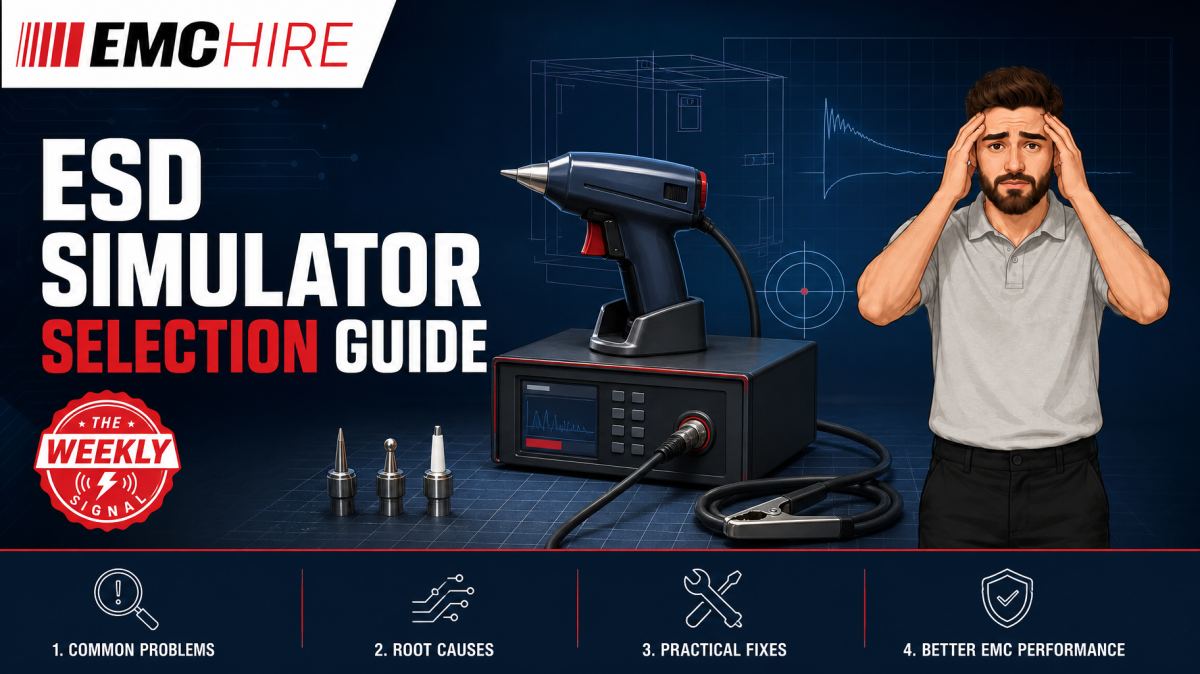
An ESD simulator with an impressive maximum voltage can still be the wrong instrument if its discharge network, waveform performance, tips, return cable or control functions do not match the test method.
Selection should start with the applicable product requirement and test objective, not the largest number printed on the gun.
Start with the product requirement, not the simulator
IEC 61000-4-2 is a basic immunity test method for electrostatic discharge. It describes the test generator, waveform, test environment and application methods, but it does not by itself establish every product's required test level, performance criterion or final configuration. Those requirements are normally called up by a product-specific or product-family standard, customer specification or contractual test plan.
Before selecting an ESD simulator, identify the applicable ports, enclosure surfaces, accessible metalwork, user controls and coupling planes. Confirm the required polarities, contact discharge and air discharge levels, number of applications, dwell or repetition requirements, and EUT performance criteria. Check the latest active editions of all relevant standards rather than assuming that a test plan inherited from an earlier programme remains valid.
This distinction matters. A gun suitable for development debugging may not offer the reporting, verification or programmable sequencing expected in a controlled formal test programme. Conversely, buying the highest-specification generator available can add cost without improving the validity of a test whose required levels are comfortably within a more modest instrument's characterised range.
Voltage range is only the first selection criterion
The simulator must cover the required positive and negative test levels with suitable margin. That margin should accommodate investigation above the specified level where the engineering plan permits it, but excessive voltage capability is not automatically beneficial. Higher-voltage instruments can be larger, heavier and more difficult to position accurately around compact products.
Resolution and accuracy across the range deserve attention. If most work is carried out at relatively low levels, an instrument optimised only for very high-voltage testing may provide less convenient adjustment or control than a simulator designed around the intended application. Review the manufacturer's stated accuracy, operating range and environmental restrictions rather than relying on the headline maximum.
Also confirm that the installed discharge network matches the applicable method. An ESD simulator contains energy-storage and discharge components that shape the current pulse. A generator configured with a network intended for another industry method may produce a different waveform even though the selected voltage appears correct. Interchangeable networks can be useful for laboratories supporting several sectors, but they create a configuration-control risk unless each network is clearly identified and recorded.
Contact discharge and air discharge are not interchangeable
Contact discharge places the conductive tip against the test point before the simulator operates its discharge switch. It normally provides better repeatability because the switching event occurs within the simulator rather than through an uncontrolled air gap. It is generally used on conductive surfaces where the applicable method permits direct application.
Air discharge uses a rounded insulating or air-discharge tip and approaches the EUT until breakdown occurs. The resulting event depends on approach speed, humidity, tip geometry, surface shape and the local electric field. Two operators can obtain different breakdown positions and therefore different current waveforms if their technique is inconsistent.
Air discharge is not a substitute for contact discharge simply because a spark is visible. It is commonly required on insulating surfaces or where contact discharge cannot be applied as specified. Excessively slow approach can allow charge leakage before breakdown, while a hesitant or angled approach can make results difficult to reproduce. The selected gun should be comfortable enough for the operator to maintain a deliberate approach across a full test campaign.
Confirm that both tips are supplied or available, mechanically secure and correctly recognised in the documented configuration. See EMC Hire's range of ESD generators and compatible ESD test accessories when planning a complete setup.
Waveform performance determines whether the result is defensible
The discharge current waveform is fast and contains substantial high-frequency energy. Generator performance cannot be established by checking the displayed charging voltage with an ordinary multimeter. Verification requires a specified current target, suitable attenuator chain, high-bandwidth measurement system and a physical arrangement consistent with the applicable method.
Review manufacturer documentation for waveform compliance, verification arrangements and any limitations associated with voltage, polarity, discharge mode or accessories. The generator's calibration status should cover the parameters needed by the test programme. EMC Hire uses test equipment with calibration traceable through an appropriate ISO/IEC 17025 accredited calibration provider. The accreditation applies to the relevant calibration provider or activity, not to the physical instrument itself.
Traceable, suitable calibration supports repeatability and comparison between development and formal testing. It does not remove the need for pre-test checks, correct simulator configuration or periodic waveform verification where required. A damaged tip, loose network, degraded return cable or unsuitable oscilloscope chain can undermine an otherwise current calibration record.
The return path is part of the generator
The discharge return cable is not a convenient safety lead that can be routed anywhere. Its inductance, proximity to conductive structures and connection to the reference ground plane influence the current path. Coiling spare cable, passing it around a bench leg or attaching it through a long improvised lead can change the pulse behaviour and increase variability.
Select a simulator with the correct return cable and termination for the intended setup. The cable should reach the required test points without being stretched, yet it should be routed as prescribed rather than bundled. For floor-standing EUTs, tall assemblies or awkward on-site installations, cable reach and operator access can become determining factors.
The wider setup also matters. IEC 61000-4-2 arrangements can involve a reference ground plane and horizontal or vertical coupling planes for indirect discharge, depending on EUT type and the applicable test configuration. Hiring only the gun while improvising the planes, insulating supports or discharge resistors can produce data that cannot be compared confidently with formal testing.
Controls, triggering and safety affect practical test quality
A useful laboratory ESD simulator should support the required polarity selection, discharge mode, repetition behaviour and shot counting. Automatic sequences reduce repetitive operator input, but they must not encourage uncontrolled testing. The engineer still needs to observe EUT behaviour, identify the actual test point and stop if an unsafe or destructive condition develops.
Remote triggering can help when the operator must remain away from moving machinery, high-energy equipment or a monitored screen. Battery operation may reduce cable interference and improve access, although battery condition then becomes part of test preparation. A low battery or unexpected shutdown halfway through a sequence can compromise records and force the point to be retested.
Check interlocks, emergency controls and audible or visual discharge indications. ESD testing can cause unexpected actuator movement, data corruption or reset behaviour. The EUT risk assessment should address functional hazards, stored energy and the consequences of inhibited controls, not merely operator exposure to the simulator.
Typical scenario
Consider an illustrative industrial controller with a painted metal enclosure, membrane keypad, Ethernet connection and external power supply. The engineering team needs to investigate resets during user interaction before booking formal testing.
The applicable product standard and test plan call up IEC 61000-4-2 for the ESD method. Contact discharge is planned for exposed conductive fixings and suitable metalwork. Air discharge is needed at insulating seams and controls, while indirect discharges to the specified coupling planes assess nearby events.
The team must choose a simulator covering the required positive and negative levels, with the correct discharge network, both tip types, a suitable return cable and evidence of appropriate calibration. They also need coupling planes, an insulating support arrangement and a method of monitoring controller operation. Selecting a bare gun without these accessories would leave them unable to reproduce the intended setup.
Early testing may show whether the reset is associated with a particular enclosure seam, cable route or user interface point. Engineers can then inspect bonding, shielding, PCB return paths, filter placement and firmware recovery before enclosure tooling is fixed. Pre-compliance data does not prove compliance, but it can reduce the financial risk of discovering the same weakness during a formal programme.
EMC Hire can support the work through equipment hire, practical setup advice, on-site testing, pre-compliance engineering or access to an EMC laboratory hire facility. Where appropriate, formal compliance testing can contribute to the technical file, EMC risk assessment, mitigation evidence and Declaration of Conformity process. The manufacturer remains responsible for confirming the applicable legislation, standards, conformity assessment route and documentation.
When to Hire EMC Equipment
Hiring an ESD simulator is often more defensible than purchasing when testing is concentrated around prototype releases or occasional compliance programmes. It provides access to the appropriate voltage range, network and accessories for a defined window without committing capital to equipment that may not suit the next product family.
Ownership also carries less visible costs. Calibration, servicing, battery replacement, storage and configuration control continue even when the simulator is unused. If a generator has several interchangeable networks, maintaining traceable records for every combination requires further discipline.
Hire can also cover project peaks when several engineering teams need immunity equipment at once. It allows a development laboratory to scale capacity without delaying debugging or taking instruments away from another programme. For an unusual customer specification, short-term access reduces the risk of buying a specialised gun that has little future use.
The hire specification should still be technically complete. State the test method, required levels, discharge modes, network, accessories, intended environment and dates. EMC Hire can help identify a suitable IEC 61000-4-2 ESD test solution, while checking practical matters such as coupling planes, tips, return leads and monitoring needs.
Common EMC Testing Mistakes to Avoid
Choosing by maximum voltage alone
A high maximum voltage does not confirm the correct discharge network, waveform, tips or control functions. The result may look severe while failing to represent the specified method.
Applying air discharge to every surface
Air discharge introduces breakdown variability and should not replace contact discharge where the test method requires contact application. Uncontrolled substitution weakens repeatability and can either exaggerate or conceal susceptibility.
Ignoring the return cable route
A coiled or extended return cable adds inductance and changes the discharge path. Measurements and EUT responses may then differ between operators or laboratories for reasons unrelated to product design.
Using an unsuitable ground plane or coupling plane
Incorrect dimensions, bonding or placement alter indirect coupling. A product may appear robust in an improvised setup yet fail when tested using the required geometry, or it may be subjected to an unnecessarily severe local field.
Testing an unrepresentative operating mode
A powered enclosure that is not communicating, switching outputs or processing data may miss its most susceptible state. Record firmware, traffic, loads, peripherals and acceptance criteria before testing begins.
Failing to record discharge points
Descriptions such as “front panel tested” are rarely adequate. Photographs, point identifiers, polarity, level, mode and observed behaviour are needed to reproduce a failure and create a defensible evidence trail.
Assuming calibration covers the complete setup
A calibration certificate does not validate improvised tips, damaged cables or an incorrectly installed network. Check the physical configuration against the certificate and manufacturer documentation before use.
Frequently Asked Questions (FAQs)
How much voltage margin should an ESD simulator have?
The instrument must cover every required level and polarity, with enough margin for agreed investigative testing. There is no universal margin because product standards, customer plans and engineering objectives differ. Avoid specifying extreme capability that adds handling complexity without a defined use.
Can one gun support IEC 61000-4-2 and automotive testing?
Potentially, if the manufacturer supports the required networks, waveforms, tips and verification arrangements. Do not assume interchangeability. Automotive or manufacturer-specific procedures may use different networks and application details, so each configuration must be checked against the current programme requirement.
Is contact discharge more severe than air discharge?
Not as a general rule. The mechanisms and repeatability differ, and the EUT response depends on the discharge point and coupling path. Apply the mode specified for the surface and method rather than trying to rank them with a single severity statement.
Can pre-compliance ESD testing support CE or UKCA self-certification?
Calibrated pre-compliance data can support engineering decisions, risk assessment and technical documentation where the selected conformity route allows it. It does not automatically demonstrate full conformity. The manufacturer or responsible economic operator must determine the applicable legislation, standards and evidence requirements.
How often should the waveform be verified?
Follow the applicable test plan, quality system, current standard and manufacturer guidance. Verification may also be appropriate after repair, suspected damage, network replacement or anomalous results. The measurement chain must have suitable bandwidth and be configured for the specified current target arrangement.
Should the simulator be purchased or hired?
Purchase may suit sustained, predictable use with internal capability to manage calibration, maintenance and accessories. Hire is often better for irregular campaigns, temporary capacity or specialist networks. Compare the complete lifecycle and technical fit, not only the initial purchase price.
Discussing the test setup before equipment selection
Send EMC Hire the applicable method, required voltage range, discharge modes, EUT type, intended test environment and accessory list before reserving equipment. The engineering team can help with an ESD simulator hire quotation, on-site testing, pre-compliance investigation, formal compliance testing where appropriate, or space at the EMC Hire test facility.
For practical support, call +44 (0)1462 817111 or email sales@emchire.co.uk. Early discussion is particularly useful when the test plan includes unusual networks, large EUTs, customer-specific procedures or monitoring requirements.
Disclaimer: Content is for informational purposes only and does not constitute formal engineering or regulatory advice. Always verify testing procedures against current official standards (e.g., ISO, MIL-STD, DEF STAN). EMC Hire Limited accepts no liability for outcomes resulting from the use of this information.