

How to decide whether to retest or redesign
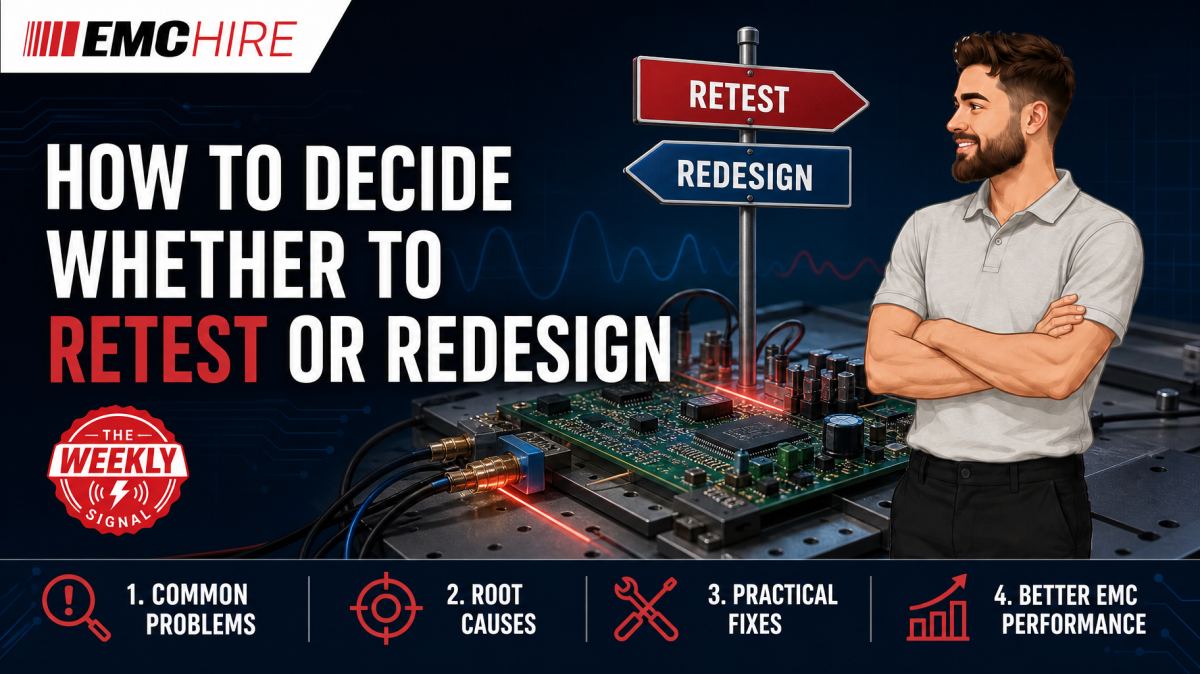
An EMC failure does not automatically justify a redesign. Nor does a narrow failure margin automatically justify another test run.
The right decision depends on whether the result represents a real product weakness, a configuration error, measurement uncertainty or an operating condition that was never properly controlled. Choosing to retest or redesign EMC performance without resolving that question can waste days in the laboratory or commit a project to unnecessary hardware changes.
Start by establishing whether the failure is technically credible
Before discussing schedule or cost, confirm that the failed result is defensible. A repeat measurement is useful only when it addresses a specific uncertainty. Repeating the same test with the same uncontrolled setup merely produces another data point.
Review the original test record against the applicable product, product-family or contractual standard. Check the latest active edition, frequency range, limits, detector, measurement bandwidth, test distance, cable arrangement, operating mode and performance criteria. IEC 61000-4-x publications describe basic immunity test methods, while CISPR publications and product-family standards commonly address emissions requirements. The applicable product standard may modify the configuration, port applicability or acceptance criteria, so the basic method alone is not enough.
For an emissions failure, examine the raw trace rather than relying only on the final table. Determine whether the disturbance is broadband, narrowband, intermittent or synchronised with a particular function. Confirm that peak, quasi-peak and average detectors were applied where required. Conducted emissions on relevant power ports may commonly be assessed from 150 kHz to 30 MHz using a suitable LISN, but that range must not be assumed without checking the applicable standard.
For immunity, record what actually happened. A reset, corrupted communication frame, analogue deviation and permanent component damage are different failure types. Each points towards a different coupling mechanism and engineering response. A vague report stating that the EUT “malfunctioned” gives project leadership little basis for deciding whether to retest or redesign.
Failure margin changes the decision, but not by itself
Margin is often treated as the deciding number. It should be treated as one input.
An emissions result fractionally above a limit may arise from cable movement, ambient noise, detector behaviour, EUT variation or genuine marginal design performance. If the product only passes when a cable is placed in one favourable position, the design has not gained useful margin. Production variation, alternative peripherals and installation differences may expose the same weakness later.
A large exceedance across a broad frequency range is less likely to disappear through controlled retesting. That pattern may indicate poor enclosure bonding, inadequate filtering, a noisy power converter or common-mode current flowing on an external cable. Retesting without modification consumes schedule while leaving the physical mechanism untouched.
Immunity margin needs equally careful interpretation. Failure at a single frequency can result from a resonant cable or enclosure structure, while failure across a wide band may point to insufficient filtering, poor PCB reference continuity or inadequate circuit-level protection. The test level and modulation must match the applicable method. A conducted RF immunity level injected through a CDN or an applicable current-injection arrangement must not be interpreted as radiated electric-field strength in V/m.
Separate setup errors from design weaknesses
A setup error justifies correction and retest. A design weakness justifies engineering work before the next formal test slot.
Evidence supporting a controlled retest may include an incorrect receiver setting, an unrepresentative EUT mode, a damaged cable, the wrong auxiliary equipment, an ambient signal mistaken for an EUT emission or a coupling device used outside its intended configuration. Each issue must be documented and corrected. “The result looked unusual” is not sufficient.
Evidence supporting redesign includes repeatable emissions linked to a switching node, immunity failures tied to a defined port, enclosure seams that carry measurable common-mode current, or a fault that persists through controlled substitution. The term redesign does not always mean a new PCB. A targeted change to a filter, cable screen termination, connector bonding method, firmware state or mechanical interface may be enough.
Diagnosis should follow the energy path. For radiated emissions, use suitable near-field probes and current probes to distinguish a local source from cable-driven radiation. For conducted emissions, investigate differential-mode and common-mode behaviour around the failing frequencies. During immunity debugging, determine whether energy enters through a cable, enclosure aperture, PCB trace or power port before adding suppression components indiscriminately.
Random ferrites sometimes improve one test point while creating cost, thermal or assembly problems elsewhere. Without identifying the coupling path, the apparent fix may also fail when cable length or load changes.
A decision framework for engineering managers
The project decision should combine technical confidence with programme exposure. Four questions usually reveal the least risky path.
Can the original result be reproduced?
If not, investigate the setup, operating mode and monitoring method before changing the design. Intermittent behaviour may still represent a real weakness, particularly when software timing, relay operation or load state changes the EUT response. Capture configuration photographs, firmware versions, cable positions and event logs.
Is the mechanism understood?
A known mechanism supports a bounded modification and verification plan. An unknown mechanism makes an immediate formal retest expensive because laboratory time becomes open-ended debugging time. Accessible pre-compliance work is usually better suited to exploratory probing and repeated configuration changes.
Does the proposed change have measurable margin?
Do not approve a modification solely because one scan falls below the limit. Compare before-and-after data using a stable setup, then challenge the change with representative cables, loads and operating modes. Calibrated engineering data improves confidence, but pre-compliance results do not automatically prove compliance.
What is the consequence of another failure?
Late-stage failure may affect laboratory availability, customer milestones, tooling, declarations and production release. If the financial consequence is high, a controlled investigation followed by a confirmation test is generally more defensible than relying on a hopeful retest.
Typical scenario
Consider an illustrative mains-powered industrial controller that fails radiated emissions at several frequencies associated with its internal switching converter. The exceedance changes when an external communications cable is repositioned, and current-probe measurements indicate common-mode current on that cable.
The team has three apparent choices: immediately repeat the formal test, add a clamp-on ferrite and retest, or modify the cable-screen termination and PCB return path. An immediate repeat is unlikely to help because the emission is repeatable and linked to a physical coupling path. A ferrite may reduce current, but selecting one without checking impedance over the affected frequency range, cable current and installation repeatability could produce a fragile production fix.
A better route is a short pre-compliance investigation using a representative ground plane, controlled cable geometry, suitable antennas and current probes. The team can compare bonding changes, filter options and operating modes, then select a modification that provides stable margin rather than a single favourable result.
EMC Hire can support this work through equipment hire, practical setup guidance, pre-compliance engineering, on-site testing and access to an EMC test facility. Where formal compliance testing is appropriate, the resulting evidence can support the technical file, EMC risk assessment, mitigation records, Declaration of Conformity and self-certification process. Testing alone does not complete every conformity obligation, and the manufacturer remains responsible for confirming the applicable legislation, standards, conformity assessment route and documentation requirements.
Early investigation reduces the chance that the formal test slot becomes an expensive debugging session. It also gives engineering managers a clearer cost and schedule estimate before authorising hardware changes.
Balancing schedule and cost
Retest cost is more than the laboratory booking. Include engineering preparation, sample transport, specialist attendance, test report revision and the delay caused if the second attempt also fails. Redesign cost should include component qualification, PCB or mechanical changes, procurement, software regression, safety reassessment and production documentation.
A small, understood correction with strong verification evidence can justify rapid retesting. A poorly understood failure with weak margin usually cannot. Decision quality improves when the project team records assumptions, confidence levels and the evidence required to close each uncertainty.
Traceability matters here. EMC Hire uses test equipment with calibration traceable through an appropriate ISO/IEC 17025 accredited calibration provider. Suitable, traceable calibration supports measurement accuracy, repeatability and comparison between development and formal testing. It also strengthens the evidence available to engineering teams, corporate stakeholders and regulatory reviewers. Accreditation applies to the relevant calibration provider or activity, not to the physical instrument itself.
When to Hire EMC Equipment
Hiring is well suited to a defined investigation or verification window. An engineering team may need a spectrum analyser, EMI receiver, LISN, antenna, current probe, CDN, amplifier or ESD simulator for several days, then have no recurring need for that configuration.
Rental avoids committing capital to equipment that may not suit the next product standard, frequency range or test level. It also avoids long-term storage, servicing and calibration overheads. This is particularly relevant where the transducers, coupling networks and accessories determine whether the setup is valid.
Short-term hire can expand internal capability during project peaks or allow engineers to reproduce a laboratory failure on the bench. Equipment selection must still follow the test method. A LISN is used for conducted emissions measurements on applicable power ports. A CDN is used for conducted RF immunity where the relevant method calls for it, while BCI probes support applicable current-injection immunity procedures in automotive, military, aerospace or product-specific programmes. These devices are not interchangeable.
Teams can review EMC Hire's EMC test guides, discuss structured skills development through EMC training, or consult the technical EMC FAQs before defining the hire package. For work involving intentional RF or high field strengths, the wider implications of RF safety and compatibility should also be considered.
Common EMC Testing Mistakes to Avoid
Retesting without preserving the failed configuration
If cable positions, EUT modes, loads, firmware and accessories are not recorded, the next setup may not recreate the original coupling path. A passing result then provides false confidence rather than evidence that the problem has been corrected.
Treating ambient noise as an EUT emission
Ambient signals can produce apparent radiated failures. Switching the EUT off, checking antenna orientation and reviewing frequency stability help distinguish the product from the environment. Redesigning around an external transmitter wastes time and may introduce new problems.
Using the wrong detector or bandwidth
Peak, quasi-peak and average detectors are not interchangeable, and resolution bandwidth depends on the applicable standard and frequency range. Incorrect receiver settings can produce invalid measurements or hide a genuine failure. Always verify the current standard rather than copying settings from an unrelated test plan.
Changing several variables at once
Replacing a filter, adding ferrites and altering bonding in one step may produce a pass, but it conceals which change worked. That weakens design justification and makes cost optimisation difficult. Controlled A/B measurements are slower per iteration but faster overall.
Using an unrepresentative operating mode
Idle mode may suppress switching activity, communications traffic or actuator loads. A retest performed in a benign state cannot resolve a failure found under maximum representative activity. Operating modes should exercise the functions most likely to generate emissions or show susceptibility.
Producing an incomplete evidence trail
A trace without equipment details, calibration status, photographs, cable geometry and EUT configuration is difficult to reproduce. Poor records weaken the technical file and make later disputes about the failure type or applied fix harder to resolve.
Frequently Asked Questions (FAQs)
How much margin is enough before booking a formal retest?
No single value applies to every product. Consider measurement uncertainty, sample variation, cable sensitivity, production tolerances and installation conditions. A stable improvement across representative configurations is more persuasive than one large margin obtained from a favourable cable position.
Should we retest after every component change?
Not necessarily through a complete formal programme. First assess which phenomena and ports the change could affect. A filter change may require targeted emissions and immunity checks, while a clock or enclosure modification may affect radiated behaviour. The final test scope should follow the applicable standard, risk assessment and any contractual test plan.
Can pre-compliance data support CE or UKCA self-certification?
Calibrated pre-compliance data may contribute to the engineering evidence used in a technical file where the legal and technical route permits self-certification. It does not automatically demonstrate full compliance. The manufacturer or responsible economic operator must determine the applicable requirements, standards, conformity assessment route and documentation.
When is a full redesign justified?
A wider redesign is justified when the failure mechanism is architectural, affects multiple ports or modes, leaves insufficient margin after practical mitigation, or cannot be controlled reliably in production. Examples include fragmented PCB return paths, unsuitable connector architecture or enclosure construction that prevents repeatable screen bonding.
Can EMC Hire support defence, automotive or aerospace investigations?
EMC Hire can provide equipment hire and pre-compliance engineering support for these sectors, including applicable BCI, transient, emissions and immunity investigations. Final testing may need an appropriately accredited laboratory depending on the contract, regulatory framework or programme requirements. The current product-specific and customer-specific test plan should be checked before selecting equipment.
Plan the next test around evidence
The strongest retest decision states what failed, why it failed, what changed and how the change was verified. If those points cannot be answered, more diagnosis is normally required before committing the project to another formal test slot.
To discuss whether your next step should be equipment hire, on-site investigation, pre-compliance work or formal compliance testing, contact the EMC Hire engineering team on +44 (0)1462 817111 or email sales@emchire.co.uk. The team can also provide a hire quotation or help arrange suitable space at the EMC Hire test facility.
Disclaimer: Content is for informational purposes only and does not constitute formal engineering or regulatory advice. Always verify testing procedures against current official standards (e.g., ISO, MIL-STD, DEF STAN). EMC Hire Limited accepts no liability for outcomes resulting from the use of this information.
Updated 31 July 2026