


How to choose a conducted emissions test site
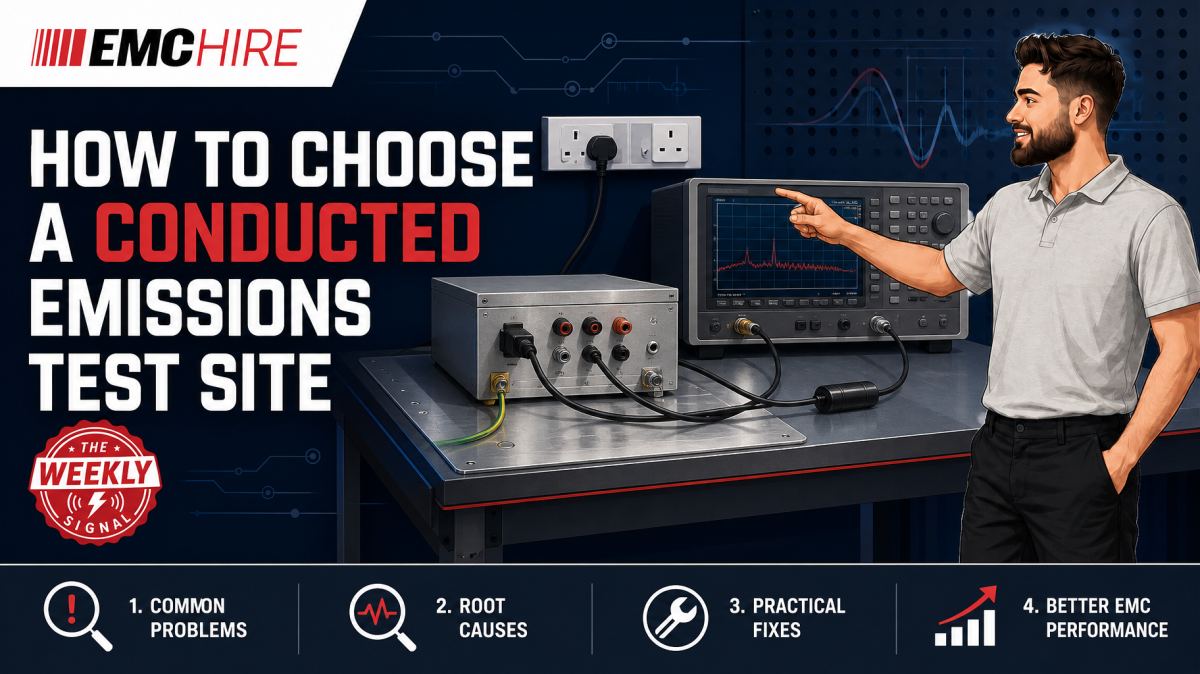
A conducted emissions result can move several decibels without any change to the EUT. Change the LISN bonding, cable layout, mains source or operating mode, and the test site may tell a different story.
Selecting a conducted emissions test site is therefore less about finding a room containing a receiver and more about controlling the measurement path. Compliance teams need an environment appropriate to the decision being made, whether that is early debugging, a design release review or formal evidence for a technical file.
Start with the purpose of the measurement
The required evidence should determine the site. A development engineer trying to locate a switching converter harmonic has different needs from a compliance manager authorising production tooling.
For early investigation, rapid access to the EUT, replaceable components and diagnostic instruments may matter more than a highly controlled formal workflow. Near-field probes, current probes, an oscilloscope and a spectrum analyser can be used alongside the measurement receiver to identify noise sources. That work is investigative. It should not be represented as proof that the finished product complies.
Pre-compliance testing raises the standard of evidence. The setup should reproduce the applicable conducted emissions method as closely as practicable, including the relevant LISN, reference ground plane, cable arrangement, EUT operating modes, receiver settings and ambient conditions. EMC Hire's conducted emissions test equipment information provides a useful starting point when defining the required measurement chain.
Formal compliance testing needs stronger configuration control, calibrated instrumentation, documented procedures and a report suitable for its intended conformity assessment route. Some products may follow self-certification, but the manufacturer or responsible economic operator remains responsible for identifying the applicable legislation, product or product-family standard, limits, conformity assessment route and documentation requirements.
The room is only part of the test site
Conducted emissions on relevant power ports are commonly measured using a LISN between the supply and the EUT. The LISN presents a defined impedance to the EUT over its specified operating range, separates the RF disturbance from the external supply and provides a measurement port for the receiver.
A shielded room can reduce interference from local transmitters, building services and neighbouring equipment, but shielding does not correct a poor RF bond or an unsuitable LISN. Equally, a chamber, turntable or open area site is not automatically required for a mains conducted emissions measurement. Those features are primarily associated with radiated testing and physical EUT manipulation. Requirements for radiated emissions measurements should be considered separately.
Look beyond the room description and examine the complete facility:
- LISN type, current rating, voltage rating, phase configuration and intended frequency range
- Measurement receiver or analyser capability, including appropriate detectors and bandwidths
- Reference ground plane dimensions, condition and bonding arrangements
- Suitable mains supply, auxiliary supplies and support equipment
- RF attenuation and transient protection between the LISN and receiver
- Methods for monitoring and exercising every representative EUT mode
- Ambient noise assessment and procedures for distinguishing EUT emissions from background signals
- Space to reproduce the prescribed cable lengths, routing and equipment separation
Current capacity deserves particular attention. A LISN that is electrically underrated for the EUT is unsafe and unsuitable. A unit chosen only for generous current capacity may also have characteristics that do not match the required method. Three-phase equipment, high inrush current, protective-earth current and regenerative power systems need to be discussed before the booking, not discovered during setup.
Formal laboratory or flexible pre-compliance facility?
When formal evidence is the objective
A controlled laboratory environment is the stronger choice when results will support a Declaration of Conformity, customer submission, mitigation record or production release. The report should identify the EUT, software, support equipment, cable arrangement, operating modes, instrumentation and deviations from the selected method.
Applicable limits usually come from a product, product-family or generic standard rather than from a LISN specification. CISPR 11 and CISPR 32 are examples containing conducted emissions requirements for products within their respective scopes, but neither should be applied merely because the equipment is available. Confirm the latest active edition, product scope, port applicability, limits, frequency range, detector sequence and documentation requirements before testing. The IEC electromagnetic compatibility resources provide useful background, while the published standard remains the controlling technical source.
Where a project or contract requires accredited testing, verify the laboratory's published scope rather than relying on a general statement about accreditation. The UK Accreditation Service provides official information on UK accreditation. Accreditation for one method or standard does not imply coverage of every product, port or measurement.
When engineering access matters more
A flexible pre-compliance site can be more productive during design. Engineers can stop a sweep, change a filter, isolate a cable or compare operating modes without consuming formal laboratory time. The setup still needs discipline. Otherwise, apparent improvements may come from moving a cable or changing the RF bond rather than from the design modification under investigation.
Accessible pre-compliance work helps teams investigate prototypes, gather calibrated engineering data and reduce late-stage redesign risk. It can improve confidence before a formal programme and support self-certification processes where legally and technically appropriate. The results do not automatically prove compliance.
When on-site measurement is appropriate
Large machinery, fixed installations and systems that cannot be transported may justify on-site EMC testing. The benefit is that the equipment can be assessed in its installed configuration with representative loads and cabling. The trade-off is reduced control over ambient RF, the supply network, grounding and surrounding equipment.
An on-site conducted emissions plan should identify available bonding points, supply topology, safe LISN insertion, current demand and how the EUT will be operated. If the normal supply cannot be interrupted or safely routed through the required network, the proposed method may need reconsideration. Any deviation must be technically justified and recorded.
Typical scenario
Consider an illustrative three-phase industrial controller approaching design freeze. Its compliance team needs to determine whether switching noise on the mains port is comfortably below the applicable limit before committing to formal testing.
A practical first step is a hired pre-compliance facility or a suitable in-house setup using a correctly rated LISN, measurement receiver, limiter and reference ground plane. The controller should be exercised at representative load, with its intended motor cable, communications interfaces and support equipment present. Software modes that change PWM frequency, clock activity or power demand should be evaluated rather than assuming the highest electrical load always produces the highest RF disturbance.
If the trace is close to a limit, configuration control becomes decisive. Cable position should be photographed, operating states logged and detector results retained. Peak scanning can locate candidate frequencies efficiently, but final comparison must use the detector and measurement settings required by the applicable standard, which may include quasi-peak and average detection. A fast peak trace alone can exaggerate some disturbances and miss the evidential requirements of the formal method.
Selecting an open area site simply because it is available would add little to this conducted measurement. Choosing an underrated single-phase LISN would be worse: the intended operating state could not be represented, and the results would not answer the compliance question. Early investigation with the correct equipment allows filter changes and grounding modifications before enclosure and PCB decisions become expensive.
EMC Hire can support that process through equipment hire, pre-compliance engineering, test facility access, on-site work and formal compliance testing where appropriate. Final testing in automotive, defence or aerospace programmes may need an appropriately accredited laboratory, depending on contractual, regulatory and programme requirements.
When to Hire EMC Equipment
Hiring is often technically and financially sensible when conducted emissions demand is irregular. A receiver and LISN may appear straightforward to purchase, but ownership also brings calibration scheduling, servicing, storage, accessory control and the risk that the equipment will not suit the next programme.
A defined rental window allows the team to select equipment around the EUT rather than force the EUT into an existing setup. That is particularly useful for unusual supply voltages, high current, three-phase products or short development peaks involving several prototypes.
Rental can avoid unnecessary capital expenditure while giving engineers time to repeat measurements after each design change. It also reduces the chance of buying a LISN or receiver whose ratings, connectors or frequency coverage are unsuitable for later products. For measurement equipment supplied by EMC Hire, calibration is traceable through an appropriate ISO/IEC 17025 accredited calibration provider. Suitable traceable calibration supports accuracy, repeatability, comparison between development and formal testing, and a stronger evidence trail for engineering and regulatory review.
Equipment selection should still start with the applicable test plan. A CDN used for conducted RF immunity testing is not a substitute for a LISN used to measure conducted emissions. Similar-looking RF hardware can perform entirely different coupling functions.
Common EMC Testing Mistakes to Avoid
Treating cable layout as an incidental detail
Mains and interface cables form part of the RF circuit. Changing their height, separation or bundling alters common-mode coupling and can move measured levels. If the formal setup cannot be reconstructed from notes and photographs, a passing development result offers weak protection against a later failure.
Bonding the LISN through a long lead
An unnecessarily long bonding lead adds parasitic inductance. At higher frequencies it raises the RF impedance to the reference plane, so the intended measurement network no longer behaves as expected. Use the prescribed low-impedance bonding arrangement and record it.
Using the wrong receiver settings
Conducted emissions are commonly investigated from 150 kHz to 30 MHz, but that range is not universal. CISPR-based measurements within that range commonly use a 9 kHz resolution bandwidth, subject to the applicable standard. Applying a radiated-emissions bandwidth, using peak detection as the final result, or copying settings from another product can produce invalid comparisons.
Ignoring the EUT's worst operating mode
An idle product may be electrically quiet while a communications burst, heater cycle or converter load transition creates the dominant disturbance. Testing only the easiest stable mode can generate false confidence. Define representative modes before arrival and provide a reliable way to exercise them.
Failing to distinguish ambient signals
Ambient RF can enter through the supply, support equipment or imperfect shielding. Switching the EUT off, examining time behaviour and repeating suspicious measurements helps separate local interference from genuine EUT emissions. Deleting unexplained frequencies without evidence damages the defensibility of the report.
Keeping an incomplete test record
A plot without LISN details, calibration status, receiver settings, software version, cable layout and operating mode is difficult to reproduce. That weakens comparison after redesign and may leave the technical file unable to explain how the result was obtained.
Frequently Asked Questions (FAQs)
Does a conducted emissions test require a screened chamber?
Not in every case. A screened environment can reduce ambient interference, but suitability depends on local noise, the EUT and the required evidence. The LISN, ground plane, receiver, supply and reproducible setup usually have more direct influence on the conducted measurement.
Can the same site perform conducted emissions and conducted immunity?
Possibly, if it has the correct equipment and controlled setups for both methods. The tests remain separate. Conducted emissions uses measurement networks such as LISNs on applicable power ports, while IEC 61000-4-6 conducted RF immunity commonly uses CDNs or another permitted injection method specified by the applicable test plan.
Is spectrum analyser data acceptable for pre-compliance?
It can be useful if the analyser has suitable frequency coverage, dynamic range, bandwidths and detectors, and if it is protected from high transients at the LISN port. For closer correlation with formal CISPR measurements, a compliant measurement receiver and the required detector sequence provide stronger data.
How much margin should a pre-compliance result have?
There is no universal safe margin. Measurement uncertainty, unit variation, cable placement, operating modes, ambient conditions and correlation with the formal site all matter. A narrow margin should trigger investigation rather than an assumption that the product will pass elsewhere.
Can conducted emissions results support CE or UKCA self-certification?
Appropriate test evidence may contribute to the technical file and Declaration of Conformity where self-certification is permitted, but testing is only part of the conformity assessment. The manufacturer must confirm applicable legislation, standards, risk assessment, documentation and production controls.
Discuss the test objective before choosing the site
The most appropriate conducted emissions test site is the one that answers the engineering question with controlled, repeatable evidence. Share the EUT supply details, applicable standards, port list, current demand, operating modes and intended use of the results before committing to a facility or rental package.
To discuss equipment hire, pre-compliance support, formal compliance testing, on-site measurements or booking space at the EMC Hire test facility, contact the engineering team on +44 (0)1462 817111 or email sales@emchire.co.uk.
Disclaimer: Content is for informational purposes only and does not constitute formal engineering or regulatory advice. Always verify testing procedures against current official standards (e.g., ISO, MIL-STD, DEF STAN). EMC Hire Limited accepts no liability for outcomes resulting from the use of this information.