

How to estimate EMC project lead time
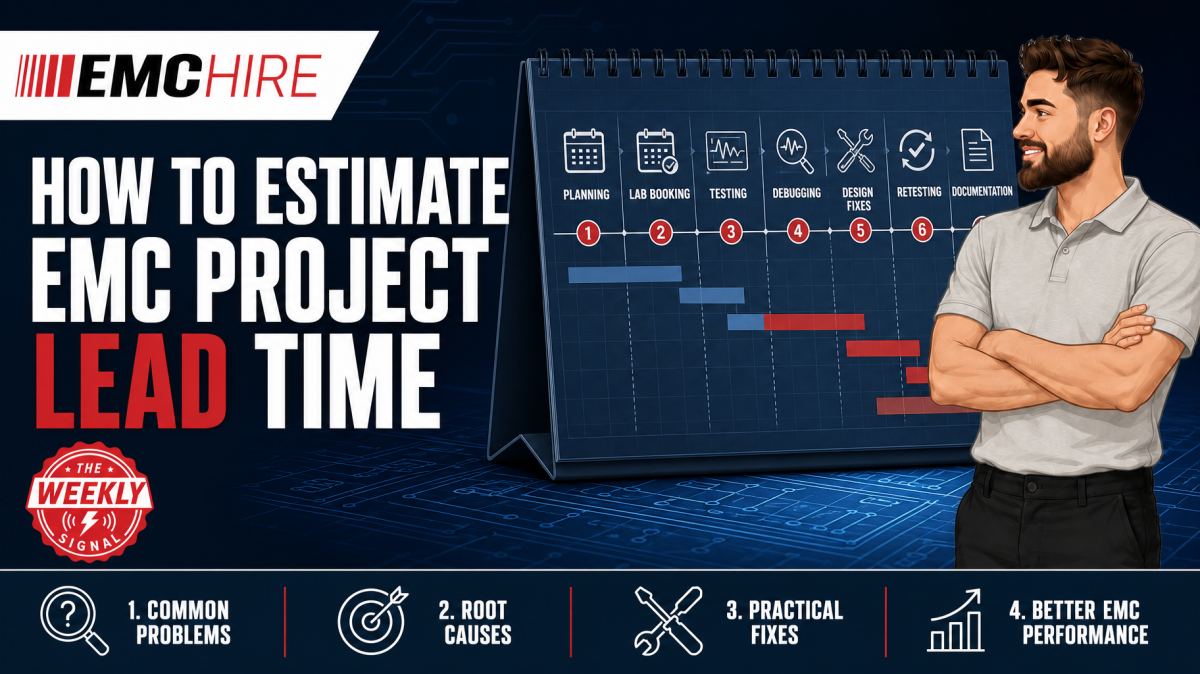
An EMC test may occupy the laboratory for two days, yet the complete EMC project lead time can easily span several weeks. The missing time is usually consumed by preparation, failed-test investigation, design fixes and access to a suitable retest slot.
Why laboratory duration is not the project duration
Project plans often contain a single task labelled “EMC testing”. That hides several dependent activities with different owners, risks and waiting times. A realistic schedule separates standards review, equipment configuration, booking, test execution, fault diagnosis, modification, retesting and documentation.
The laboratory phase is only one part. If a radiated emissions failure requires a printed circuit board change, the limiting task may become layout, fabrication and assembly rather than EMC engineering. If the corrective action is a firmware update, regression testing and release control may dominate instead. Planning only for chamber occupancy produces a schedule that appears efficient until the first non-conformity is found.
Estimate the programme as a sequence of ranges, not a single optimistic number. Assign an owner and entry condition to each stage. Laboratory booking should not begin the clock for test readiness. The equipment under test, or EUT, must already be sufficiently stable, representative and documented before it consumes booked facility time.
Build the estimate around defined test stages
Standards and scope review
Start by identifying the applicable legislation, product or product-family standards, ports, operating environments and intended markets. Generic EMC assumptions are not enough. A multimedia product, industrial drive, radio product and automotive subassembly can have materially different configurations, frequency ranges, performance criteria and evidence requirements.
The manufacturer or responsible economic operator remains responsible for confirming the applicable conformity route. Check the latest active editions, amendments, test levels, limits, frequency ranges, operating modes and documentation requirements. Customer or contractual specifications may add tests beyond regulatory requirements, particularly in defence, automotive and aerospace programmes.
Allow time for technical review where product classification is uncertain. Discovering after the booking that a DC cable should have been configured as a long external port, or that an additional enclosure mode must be exercised, can invalidate the planned duration.
Test plan and configuration definition
A useful test plan describes more than a list of standards. It should identify the EUT variants, power arrangements, cable types and lengths, auxiliary equipment, software modes, monitored functions and pass or fail criteria. It should also state which configuration is expected to produce the highest emissions or greatest immunity susceptibility.
Representative accessories need to be available. Even an apparently minor mains lead choice can alter cable routing, common-mode current and the practical setup. Where relevant to the product configuration, arrange the specified 13 A Euro mains lead or 3 A fused Euro mains lead before the test day. These links do not establish which lead is correct for a product. That decision must follow the rated current, safety design and intended supply arrangement.
Missing cables, debug interfaces or loads create dead laboratory time. Worse, engineers may substitute an unrepresentative accessory to keep testing moving, leaving results that cannot confidently support the final production configuration.
Equipment and facility booking
Booking lead time depends on the required environment and equipment combination. A conducted emissions investigation using an appropriate LISN and receiver has different facility needs from radiated immunity testing using an antenna, RF amplifier, field monitoring system and suitable test environment. Conducted RF immunity under IEC 61000-4-6 generally calls for a CDN or another coupling method permitted by the applicable setup. A BCI probe belongs to applicable current-injection immunity procedures and is not an automatic substitute for a CDN.
Send the facility a concise scope before requesting dates. Include EUT dimensions and mass, supply voltage and current, RF transmitters, support equipment, test distance where applicable, monitoring needs, hazards and estimated setup time. Large equipment, high-current supplies, unusual connector systems or remotely located loads can require additional engineering preparation.
Do not assume the earliest available slot is suitable. Confirm that the facility and test equipment cover the methods, levels and frequency ranges in the plan. For formal work, also agree the reporting scope and any witnessing arrangements before purchase orders and dates are fixed.
Pre-compliance investigation
Pre-compliance work should sit before the formal programme, not in the spare afternoon immediately preceding it. Accessible measurements allow engineers to identify dominant emissions, cable coupling paths and immunity weaknesses while hardware changes are still practical.
For example, a conducted emissions scan may show whether disturbance voltage on a relevant power port is concentrated around a converter switching family. Radiated investigation can then establish whether enclosure apertures or external cables are driving the response. These measurements do not automatically prove compliance, but calibrated engineering data provides a far better basis for design decisions than probe readings with unknown correction factors.
EMC Hire uses test equipment with calibration traceable through an appropriate ISO/IEC 17025 accredited calibration provider where calibration is relevant to the measurement. This supports repeatability and comparison between development and formal testing. Information about the role of accredited calibration is available from UKAS calibration guidance.
Formal test execution and reporting
Formal compliance testing should be planned around the complete configuration matrix. Setup changes can take longer than individual sweeps or immunity exposures, particularly where cables, antennas, orientations, operating modes and auxiliary equipment must be rearranged and documented.
Radiated emissions commonly begin at 30 MHz, while conducted emissions on relevant power ports are commonly assessed from 150 kHz to 30 MHz. Those ranges are not universal. The applicable product standard determines the actual range, detector use, measurement bandwidth, limits and configuration. Peak measurements may support efficient prescanning, while quasi-peak or average results may be needed where required by the applicable emissions standard.
Reporting also consumes engineering time. A defensible record needs identifiable equipment, calibration status, photographs, cable arrangements, operating modes, environmental details, results and deviations. Formal evidence may support the technical file, EMC risk assessment, Declaration of Conformity, mitigation records and self-certification route where legally and technically applicable. Testing alone does not complete every conformity obligation.
Allow explicitly for fixes and retest
A zero-failure schedule is not a controlled schedule. It is a bet.
Create a retest branch before testing begins. Define who can approve component changes, who owns firmware releases, whether spare assemblies exist and how quickly modified hardware can return. The expected duration should reflect the likely class of corrective action:
- Configuration or firmware changes may be quick, but still require regression and version control.
- Cable ferrites, bonding changes or filter substitutions require parts, installation and confirmation that safety or functional performance is unaffected.
- Enclosure tooling, PCB layout or power architecture changes can extend the programme by weeks or months.
- Changes to a representative production assembly may require quality approval and updated build documentation.
Reserve a provisional retest window where programme risk justifies it. Without one, a two-day fix can be followed by a multi-week wait for the next appropriate facility slot. Release the reservation promptly if it is no longer required.
Typical scenario
Consider an illustrative mains-powered controller approaching a planned UK and EU launch. It has Ethernet, several sensor cables and an external switched load. The project manager initially assigns two days for EMC testing because the anticipated laboratory campaign fits into two days.
A better plan begins with a scope and configuration review. The team must decide which cable lengths represent intended use, which load state creates the worst converter activity, whether communications traffic is continuous and how functional degradation will be monitored during immunity testing. The relevant product standard must be checked rather than assuming that a generic test method defines the complete requirements.
Pre-compliance measurements are then scheduled while component and PCB changes remain possible. Conducted emissions use a suitable LISN on the relevant mains port. Radiated emissions use an appropriate antenna and measurement environment. Conducted RF immunity, if called up by the product standard, uses the coupling method specified for the relevant port. Substituting one arrangement for another merely because equipment is available risks collecting misleading data.
If pre-compliance identifies cable-borne common-mode current, the team can investigate bonding, filtering and cable termination before the formal booking. A failure found at the end of the programme could otherwise trigger enclosure modification, another build and a delayed retest.
EMC Hire may support this workflow through equipment selection, EMC equipment hire, accessible pre-compliance work, on-site testing, facility access and formal compliance testing where appropriate. The team can also help distinguish between a debugging setup and the controlled setup needed for stronger compliance evidence. For wider practical material, see the EMC test guides and EMC Hire’s discussion of RF safety and compatibility.
When to Hire EMC Equipment
Hiring is often appropriate when the investigation window is defined but the long-term test requirement is uncertain. A receiver, LISN, transient generator, CDN, current-injection system or near-field probe set may be needed intensively for one development phase and then remain unused for months.
Rental avoids unnecessary capital expenditure and reduces exposure to storage, servicing and calibration overheads. It also lets a team select equipment for the actual method rather than trying to force an existing instrument into an unsuitable role. That distinction matters. An analyser without suitable dynamic range, detectors or transducer correction data may produce attractive plots but weak evidence.
Short-term hire can also scale an internal capability during project peaks or support on-site debugging before a formal booking. Confirm bandwidth, output level, accessories, software, coupling devices and calibration status against the planned work. Buying too early can leave the organisation owning equipment that does not suit the next product family or revised programme requirement.
Common EMC Testing Mistakes to Avoid
Treating the EUT as test-ready without an entry review
Unstable firmware, missing loads and unfinished harnesses turn test time into product integration time. Results from an incomplete build may not represent production hardware, so apparently successful measurements provide false confidence.
Changing cable routing without recording it
Cable position affects common-mode coupling and antenna behaviour. If routing changes between debug and retest without photographs and dimensions, engineers cannot tell whether a design fix worked or the setup simply became less severe.
Using the wrong coupling or measurement device
A LISN is used for relevant conducted emissions measurements, while a CDN is used for applicable conducted RF immunity testing. Confusing the two invalidates the method. Likewise, BCI probe selection and placement must follow the applicable current-injection procedure rather than an improvised position.
Testing only a convenient operating mode
Idle mode often understresses clock activity, data traffic and power conversion. Missing the highest-emission or most susceptible state can produce a clean report for an unrepresentative configuration.
Leaving documentation until the end
Photographs, serial numbers, software revisions, cable layouts and anomalies are difficult to reconstruct later. Incomplete records weaken repeatability and may leave the technical file unable to explain which product variant was assessed.
Frequently Asked Questions (FAQs)
How much contingency should an EMC project include?
There is no defensible universal percentage. Base contingency on design maturity, previous platform data, configuration count, hardware replacement time and facility availability. A derivative product with proven EMC architecture carries different risk from a new high-power switching design with long external cables.
Should we book a retest before the first test?
For launch-critical programmes, a provisional slot can reduce schedule exposure. Check cancellation terms and choose a date that allows realistic diagnosis and modification. A next-day retest is of little value if the likely fix requires a PCB build.
Can pre-compliance testing replace formal compliance testing?
Not automatically. Pre-compliance helps investigate risks and improve confidence, but its setup and evidence may not satisfy the chosen conformity route or stakeholder requirements. Some products can follow self-certification routes, although the manufacturer must confirm the applicable legislation, standards and documentation.
When should documentation work begin?
Begin during test planning. Record configurations and evidence as testing proceeds, then allow a separate review period after results are available. Waiting until launch week increases the risk of missing revisions, accessories or unexplained deviations.
Can on-site testing shorten the schedule?
It can where equipment is difficult to transport or rapid design iteration is needed. Site ambient noise, space, grounding arrangements and available power may limit certain measurements, so suitability should be reviewed before assuming equivalence with a controlled facility.
How early should we contact the test provider?
Contact should begin once the intended markets, product architecture and broad programme dates are known. Early discussion can expose facility, power, monitoring or configuration constraints before they become booking-critical.
Turn the estimate into a controlled engineering plan
A credible EMC project lead time includes scope review, test preparation, representative hardware, booking, pre-compliance investigation, formal testing, corrective action, retest and documentation. Keep those activities visible in the programme, with clear owners and realistic dependencies.
To review a test schedule, request an equipment hire quotation, arrange on-site testing, discuss pre-compliance or formal compliance work, or book space at the EMC Hire test facility, contact the engineering team on +44 (0)1462 817111 or email sales@emchire.co.uk. A short technical discussion before dates are committed can prevent the booking itself from becoming the programme’s first EMC design review.
Disclaimer: Content is for informational purposes only and does not constitute formal engineering or regulatory advice. Always verify testing procedures against current official standards (e.g., ISO, MIL-STD, DEF STAN). EMC Hire Limited accepts no liability for outcomes resulting from the use of this information.