

What makes an EMC lab suitable for pre-compliance work
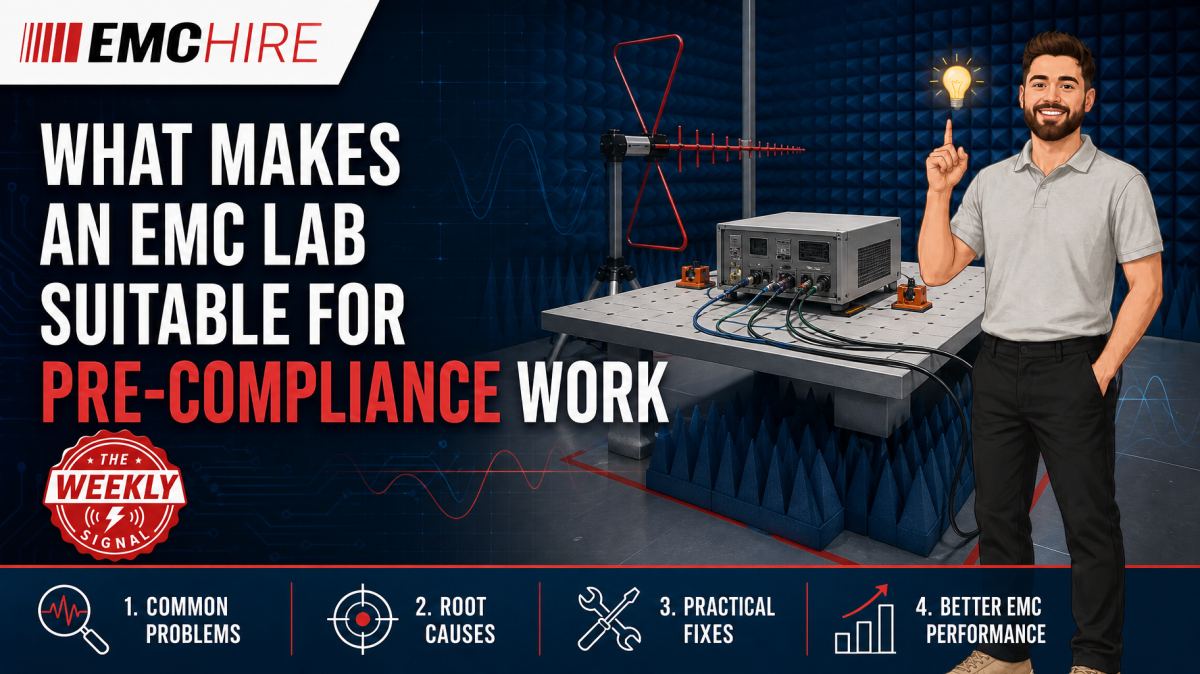
A quiet chamber and an expensive receiver do not automatically make a useful EMC pre-compliance lab. If the layout, operating mode or cable configuration cannot be reproduced, a clean-looking plot may offer little protection against failure during formal testing.
What should an EMC pre-compliance lab achieve?
Pre-compliance work has a different purpose from simply producing a pass or fail result. It should expose coupling mechanisms, identify dominant noise sources, test corrective changes and provide enough measurement confidence for the product team to make defensible design decisions.
That requires more than test equipment. The environment must support controlled measurements while remaining accessible enough for debugging. Engineers need to reach the equipment under test, exchange cables, apply temporary shielding, alter firmware states and compare design revisions without destroying the reference configuration.
A good EMC pre-compliance testing service should help answer practical questions. Is the disturbance genuinely generated by the product? Which cable carries the common-mode current? Does the enclosure seam radiate, or is the attached harness acting as the antenna? Is an immunity upset caused by direct coupling, a cable path or inadequate power integrity?
Pre-compliance results do not automatically prove conformity. They should instead reduce uncertainty before a formal test programme and produce calibrated engineering data that can be compared with later results.
Layout determines whether results are repeatable
The physical layout is part of the measurement system. Cable height, excess cable treatment, support material, peripheral position, grounding and the distance between the EUT and transducer can all change the measured result.
For radiated emissions work, the laboratory needs enough controlled space to establish the selected measurement geometry and to rotate or otherwise investigate the EUT where the method requires it. Antenna polarisation, height and distance must be handled consistently. A casual change in cable position can move a resonance or alter common-mode current, producing a result that cannot be repeated at the next test session.
Conducted emissions require equal discipline. A LISN is used on relevant power ports to present a defined impedance and provide a measurement port for the disturbance voltage. Its placement, bonding, cabling and connection to the reference ground plane affect the result. A poorly bonded LISN or an unsuitable ground plane can change the return path and create either false confidence or an apparent failure that disappears in a controlled setup.
Conducted emissions measurements are commonly required from 150 kHz to 30 MHz, but that range is not universal. The applicable product or product-family standard must define the actual frequency range, limits, detector use and configuration. CISPR 11 and CISPR 32 are examples of standards containing emissions requirements for products within their respective scopes.
For immunity work, layout remains just as influential. A CDN used for IEC 61000-4-6 conducted RF immunity is not interchangeable with a bulk current injection probe specified by an automotive, military or aerospace procedure. The coupling device, cable arrangement, calibration process and injection level must match the selected method. Otherwise, the applied stress is not meaningfully related to the intended test.
Ambient control and measurement uncertainty
An EMC pre-compliance lab must distinguish EUT emissions from the surrounding RF environment. Broadcast services, mobile communications, nearby switch-mode supplies and laboratory equipment can all appear on a spectrum plot. If ambient signals are not identified, engineers may spend hours redesigning a circuit that was never the source.
Shielding and absorber performance matter, but so does measurement discipline. A useful investigation may include an ambient scan with the EUT switched off, comparison of powered and unpowered states, current-probe measurements on suspect cables and near-field probing around the PCB. None of these steps replaces the applicable compliance method. Together, they make diagnosis much faster.
The receiver or spectrum analyser must cover the required frequency range and support the appropriate bandwidths and detectors. Peak detection is useful for rapid exploratory sweeps, while quasi-peak and average detectors may be required for final emissions assessment where specified. Resolution bandwidth must follow the applicable method and frequency range. Applying one analyser setting to every scan can change indicated amplitudes and make limit comparisons invalid.
EMC Hire uses test equipment with calibration traceable through an appropriate ISO/IEC 17025 accredited calibration provider. The accreditation relates to the calibration laboratory or activity, not to the physical instrument. Suitable traceable calibration supports repeatability, confidence in recorded data and comparison between development measurements and later formal testing. Information about calibration laboratory accreditation is available from UKAS.
Debugging access is more useful than a polished report alone
A pre-compliance session should permit controlled experimentation. If a laboratory only allows the EUT to be placed in position and scanned, the team may learn that it has a problem without learning why.
Useful diagnostic resources can include near-field probes, RF current probes, voltage probes, suitable oscilloscopes, spectrum analysis, temporary ferrites, conductive tape and representative cable accessories. Their purpose is not to disguise a failure. They help isolate the coupling path so that the permanent design correction addresses the mechanism rather than the symptom.
Suppose a radiated emission falls after a clamp ferrite is fitted to an external cable. That does not immediately prove the production solution should be a ferrite. It indicates that common-mode cable current is likely contributing to radiation. The better long-term correction might be improved connector bonding, a revised filter return, lower transfer impedance at the enclosure interface or reduced internal excitation.
Access to firmware controls is equally valuable. A product that is tested only while idle may miss emissions from its highest data-rate state or immunity failures during a safety-related control action. Operating modes should exercise representative clocks, communications, loads, motors, displays and radio functions. Where several worst-case modes are plausible, the test plan should state how each will be investigated.
Engineering support and a route to formal testing
Experienced support changes the value of a laboratory session. A test engineer should be able to challenge an unrepresentative setup, recognise overload or ambient artefacts and explain why a change affects the result. That judgement prevents product teams from treating every movement on a trace as evidence of design improvement.
The starting point is the applicable product or product-family standard, not simply a familiar basic test method. The IEC 61000-4-x series describes basic immunity methods such as electrostatic discharge, radiated RF immunity, electrical fast transient or burst, surge and conducted RF immunity. Product standards determine which methods apply, the relevant ports, performance criteria, levels and configuration.
Before testing, verify the latest active edition, product scope, test levels, limits, frequency ranges, operating modes, equipment configuration and documentation requirements. Customer specifications and contractual test plans may add further conditions, particularly in defence, automotive and aerospace programmes. EMC Hire can provide pre-compliance support in these sectors, although final programme testing may require an appropriately accredited laboratory depending on the contract or regulatory route.
Where appropriate, EMC Hire can support the progression from early investigation to formal EMC compliance testing. Formal evidence can contribute to the technical file, EMC risk assessments, mitigation records, a Declaration of Conformity and customer review. It does not remove the manufacturer's responsibility to identify applicable legislation, standards and conformity assessment requirements.
For products following a self-certification route, calibrated measurements and a reasoned test plan can strengthen the evidence trail. Further practical support is available through EMC Hire's CE marking testing and engineering services, without implying that testing alone completes every conformity obligation.
Typical scenario
Consider an illustrative product team developing an industrial controller with Ethernet, switched power conversion and several long sensor cables. Early bench scans show broad emissions, but the office environment contains strong ambient signals and the cable arrangement changes between measurements.
In an EMC pre-compliance lab, the team can establish a documented EUT layout, exercise representative processor and communications loads, perform conducted emissions measurements on relevant power ports and investigate radiated emissions using a controlled antenna setup. Current probes and near-field probes can then help separate PCB sources from cable-driven radiation.
The team must decide which operating modes are worst case, whether peripherals are representative and how cables should be terminated. Selecting the wrong LISN, using an unsuitable antenna range or applying arbitrary analyser settings would make comparison with the intended compliance method unreliable.
Early investigation may reveal that the sensor harness current changes substantially with connector bonding. That observation gives the design team a mechanism to investigate before committing to enclosure tooling or PCB release. EMC Hire can support equipment selection, laboratory setup, pre-compliance engineering, on-site testing and subsequent formal testing where appropriate.
Hiring the laboratory and diagnostic equipment for a defined window also avoids purchasing instruments that may not suit the next product. It removes much of the storage, servicing and calibration burden while allowing the team to expand test capacity during a development peak.
When to Hire EMC Equipment
Equipment hire makes engineering sense when demand is irregular, the required measurement range changes between programmes or the project needs several instruments for a short debugging phase. Buying a receiver, LISNs, antennas and probes for one investigation can tie up capital without creating a complete or maintainable test capability.
Hiring also allows the equipment to be matched to the defined test window. The receiver bandwidth, antenna range, LISN rating, CDN type or BCI probe characteristics can be selected for the intended method rather than chosen as a compromise for uncertain future work.
Ownership brings continuing costs. Instruments require suitable storage, periodic calibration, maintenance and competent setup. Accessories are also easy to overlook. A capable analyser without the right transducer, limiter, cable or preamplifier may not produce a safe or useful measurement chain.
For teams that have suitable premises and engineering resource, equipment hire can support in-house investigation. Where environmental control or specialist support is needed, hiring an EMC laboratory provides the equipment and test environment together. On-site support can be considered for large, fixed or operationally complex EUTs that cannot readily be transported.
Common EMC Testing Mistakes to Avoid
Treating cable position as an incidental detail
External cables can become efficient radiating or receiving structures. Moving a harness between scans changes its coupling and current distribution, so apparent improvements may be caused by geometry rather than the design modification. Photograph and measure cable positions.
Using an unsuitable ground plane or poor bonding
Long bonding straps add parasitic inductance. At higher frequencies, the resulting impedance can alter the return path and make a conducted or immunity setup unrepresentative. Follow the selected method's grounding arrangement rather than improvising a convenient connection.
Comparing limits with the wrong detector or bandwidth
A fast peak scan is useful for finding frequencies of interest, but it may not provide the detector result required by the emissions standard. Incorrect resolution bandwidth also changes displayed amplitude and noise response. Record receiver settings with every retained plot.
Testing an unrepresentative operating mode
An idle processor, disconnected load or inactive network interface may suppress the dominant disturbance source. The resulting margin is false confidence. Define and record software version, traffic state, load, peripherals and fault-monitoring behaviour.
Failing to preserve the evidence trail
A plot without EUT configuration, cable layout, equipment identity, calibration status and test settings is difficult to reproduce. Poor records also weaken comparison with formal testing and may be unsuitable for inclusion in a technical file.
Frequently Asked Questions (FAQs)
Does an EMC pre-compliance lab need to reproduce a formal chamber exactly?
Not always. It should reproduce the relevant coupling paths and test geometry closely enough to support the decisions being made. Any departures from the formal method should be understood, documented and considered when setting design margin.
How much margin should a product have during pre-compliance testing?
There is no universal figure. Margin should reflect measurement uncertainty, differences between sites, prototype maturity, production variation and configuration risk. A stable result several decibels below a limit is more useful when its setup is reproducible than a larger margin obtained from an uncontrolled arrangement.
Can spectrum analyser measurements replace an EMI receiver?
They can be highly effective for diagnostics if the analyser has suitable frequency coverage, dynamic range, bandwidths and detectors. Whether it is suitable for a specific compliance measurement depends on the applicable standard, instrument implementation and test objective.
Should immunity testing be included in pre-compliance work?
Yes, where the product requirements include immunity. Early ESD, conducted RF, radiated RF or transient investigation can expose resets, data corruption and degraded operation before the design is frozen. The chosen tests and coupling devices must match the applicable product requirements.
Can pre-compliance data be used in a technical file?
It may contribute useful engineering and mitigation evidence, particularly where the route permits self-certification, but its adequacy depends on the applicable legislation and conformity assessment approach. The manufacturer or responsible economic operator must make that determination.
Discuss the test requirement before booking
The most productive laboratory booking starts with the product standard, interfaces, operating modes, physical size and current development risk. EMC Hire can help select suitable hire equipment, plan a pre-compliance investigation, arrange on-site testing, discuss formal compliance work or book space at the EMC Hire test facility.
To review the proposed setup or request an equipment hire quotation, contact the EMC Hire engineering team on +44 (0)1462 817111 or email sales@emchire.co.uk.
Disclaimer: Content is for informational purposes only and does not constitute formal engineering or regulatory advice. Always verify testing procedures against current official standards (e.g., ISO, MIL-STD, DEF STAN). EMC Hire Limited accepts no liability for outcomes resulting from the use of this information.