

How to choose between a chamber and a pre-compliance rig
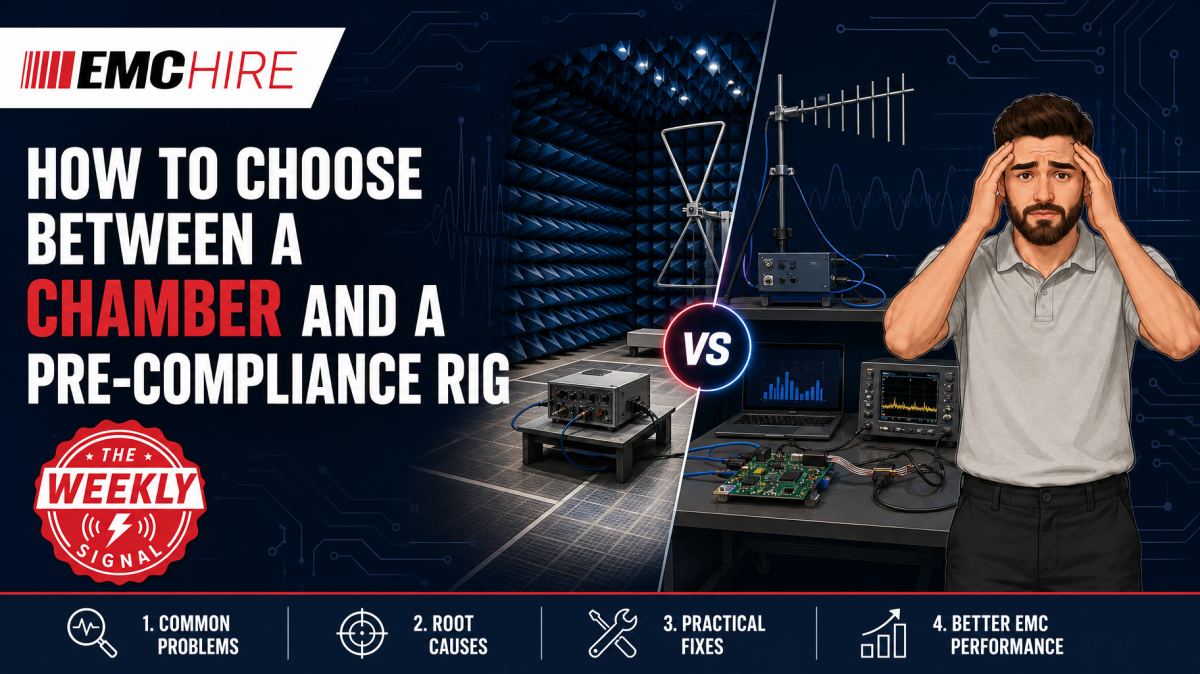
A compact rig can reveal an EMC problem in minutes, but it can also conceal one if the coupling path, ambient environment or test geometry is poorly controlled.
Choosing between a chamber and a pre-compliance rig is therefore not simply a cost decision. It is a decision about the quality of evidence required, the uncertainty the project can tolerate and the consequences of discovering a problem late.
Chamber vs pre-compliance rig: the engineering distinction
An EMC chamber provides a controlled electromagnetic environment with defined geometry, characterised site performance and reduced exposure to external radio signals. Depending on its design, equipment and validation, it may support radiated emissions, radiated immunity or both. It can also accommodate conducted tests using suitable LISNs, CDNs, transient generators and other coupling devices.
A compact pre-compliance rig is usually assembled around the immediate development need. It might include a spectrum analyser or measuring receiver, near-field probes, current probes, antennas, LISNs, transient generators, CDNs or an RF amplifier. The rig may be installed in an engineering laboratory, screened room or temporary test area rather than a fully characterised chamber.
The difference is not that one setup measures EMC and the other does not. Both can produce useful engineering data. The distinction lies in measurement control, uncertainty, reproducibility and the strength of the resulting evidence.
Formal compliance work normally requires closer adherence to the applicable product or product-family standard, including its specified test environment, equipment, operating modes, detector functions, bandwidths, distances and EUT arrangement. A chamber supports that discipline. Chamber use alone does not make a test formal, accredited or compliant with a standard. The test method, facility performance, instrumentation, competence and reporting all matter.
What the project needs to learn
Start with the decision that the measurement must support. During schematic development or first prototype integration, the team may only need to identify whether a switch-mode converter, clock edge or cable common-mode current is likely to cause difficulty. A compact rig is often the faster tool because engineers can change components, reroute cables and repeat measurements without consuming a formal chamber booking.
Later in the programme, a statement such as “the noise fell by 8 dB on our bench” may not answer the real question. Management may need to know whether the final configuration is likely to meet a product-family emissions limit, whether immunity performance criteria can be demonstrated, or whether test evidence is suitable for inclusion in the technical file. Those questions demand tighter configuration control and, in many cases, chamber-based testing.
Pre-compliance results do not automatically prove compliance. They reduce uncertainty. Used properly, they identify dominant noise sources, coupling paths and configuration sensitivities before the product enters a more controlled test programme.
Cost must include redesign exposure
A pre-compliance rig normally has a lower direct test cost and allows rapid iteration. That advantage disappears if the setup gives false confidence and the product reaches formal testing with an unresolved cable radiation problem. At that point, a failed test can affect enclosure tooling, PCB release, software validation, procurement and launch dates.
Chamber time is more expensive per hour because the facility represents a controlled test resource. Yet the relevant comparison is total programme cost, not the hourly rate. A well-planned chamber session near a design gate can be less expensive than repeated informal measurements that never establish whether the product has sufficient margin.
Engineering managers should consider three costs separately:
- the direct cost of equipment, facility time and engineering support;
- the opportunity cost of tying up development staff and prototypes;
- the financial exposure created by an incorrect pass or fail decision.
A productive strategy commonly uses both methods. The rig supports frequent development measurements, while chamber sessions provide higher-confidence correlation points and controlled evidence at selected milestones.
Space and electromagnetic control
A bench setup occupies less space, but physical size is not the same as electromagnetic suitability. Metal furniture, nearby cables, building wiring and test equipment can alter current return paths or antenna coupling. Moving an EUT by a few centimetres may change a result enough to obscure whether a design modification actually helped.
Ambient signals create another problem. Broadcast, mobile and local digital transmissions can appear as narrowband peaks during radiated emissions work. If the team cannot separate ambient signals from EUT emissions, it may spend hours debugging a source that is not inside the product. Conversely, an EUT emission can sit beneath a varying ambient signal and go unnoticed.
A chamber reduces these effects and allows prescribed test distances and antenna arrangements to be established more consistently. It also provides a safer and more controlled environment for radiated RF immunity, where calibrated field levels in V/m must be generated over the required area. Attempting that work in an occupied, unscreened laboratory can expose other equipment to RF energy and produce a poorly controlled field.
Compact rigs remain highly effective for near-field scanning and conducted-path investigation. A magnetic near-field probe can locate high-frequency current loops, while a current probe can show common-mode current on an external cable. These measurements are diagnostic. They should not be mistaken for a direct substitute for a standards-based radiated emissions result in dBµV/m.
Repeatability depends on the whole setup
Repeatability is often treated as an instrument specification. In practice, the EUT and its cables are frequently the larger source of variation. Cable height, orientation, support, termination and excess length can materially change emissions and immunity coupling.
A chamber makes repeatable geometry easier to maintain, but only if the setup is documented and reproduced. Photographs, cable dimensions, software versions, peripheral models, load conditions and operating modes should be recorded. Without those details, a return visit may produce a different result even with the same measuring receiver and antenna.
For a pre-compliance rig, establish fixed reference points. Mark antenna and EUT positions, use consistent cable supports, retain representative peripherals and record analyser settings. Where conducted emissions are being investigated on an applicable power port, use a suitable LISN and observe the required reference-ground arrangement. A LISN stabilises the impedance presented to the EUT and provides a defined measurement port. It does not turn an uncontrolled bench into a compliant test site.
EMC Hire uses test equipment with calibration traceable through an appropriate ISO/IEC 17025 accredited calibration provider. Suitable, traceable calibration supports measurement accuracy, repeatability and comparison between development and formal testing. Accreditation applies to the relevant calibration provider or activity, not to the physical instrument itself. Further information about accreditation principles is available from UKAS.
Throughput is governed by change time
For debugging, throughput means the number of meaningful design iterations completed in a day. A local pre-compliance rig can perform well because an engineer can replace a filter, alter a bonding point or load new firmware and immediately repeat the measurement.
Chamber throughput is different. Setup, verification, ambient checks, field calibration where applicable and controlled test execution consume time, but the resulting data carries greater confidence. Poor preparation wastes that advantage. If the EUT arrives without remote control, representative loads or a method of exercising worst-case modes, expensive facility time is spent solving logistics rather than testing EMC performance.
Book chamber work when the hardware and operating configuration are mature enough to justify controlled measurement. Use a rig when rapid access and diagnostic flexibility matter more than formal geometry. If several projects peak together, hired instrumentation or laboratory space can expand throughput without creating a permanent ownership burden.
Typical scenario
Consider an illustrative industrial controller with Ethernet, long sensor cables and an external mains power supply. Early prototypes show broadband noise around the processor and narrowband components associated with internal clocks. The engineering manager must decide whether to reserve a chamber immediately or build a compact investigation setup.
An effective first stage could use near-field probes to identify local sources, a current probe to assess cable common-mode current and a suitable LISN for conducted emissions investigation on the relevant power port. Receiver or analyser bandwidths and detectors must follow the applicable method when comparing results with limits. Peak detection may accelerate exploratory scans, but final emissions assessment may require quasi-peak or average measurements where specified.
The team should then select operating modes that exercise network traffic, sensor interfaces, displays, switching loads and power conversion. Testing only an idle mode risks missing the configuration that produces the highest disturbance.
Once the dominant sources are understood and mitigations are stable, a chamber session can examine the complete product with representative cables and peripherals. This provides a stronger correlation point before formal compliance testing. If radiated immunity is required by the applicable product standard, the chamber also offers controlled field generation and monitoring that a general engineering bench cannot provide.
Choosing only the chamber can slow early debugging because every modification consumes booked facility time. Choosing only the rig can leave uncertainty around ambient signals, site effects and standards-based geometry. EMC Hire can support the work through EMC pre-compliance testing, equipment selection, on-site investigation and EMC laboratory hire.
Selecting the applicable compliance route
The chamber vs pre-compliance rig decision should follow the applicable product requirements, not replace that assessment. Product and product-family standards may define emissions limits, immunity tests, performance criteria, port applicability and operating configurations. IEC 61000-4-x publications are basic immunity test methods, while product standards determine whether and how those methods apply to a given product.
Check the latest active editions, frequency ranges, test levels, limits, equipment configurations and documentation requirements. The International Electrotechnical Commission provides information about IEC standardisation, although the purchased standard and relevant national adoption must be consulted for the detailed requirements.
For CE or UKCA-related work, the manufacturer or responsible economic operator remains responsible for confirming the legislation, conformity assessment route and technical documentation required. Robust EMC evidence can support the technical file, EMC risk assessment, Declaration of Conformity and mitigation record, but testing alone may not satisfy every obligation. EMC Hire provides CE marking test support and services for commercial CE marking programmes where appropriate, without acting as a certification body.
When to Hire EMC Equipment
Hiring is well suited to irregular development demand. A team may need a measuring receiver, LISN, current probe or immunity generator for three weeks, then have no comparable requirement for months. Purchasing creates servicing, calibration, storage and utilisation questions long after the immediate project has ended.
Rental also reduces the risk of buying an instrument that lacks the bandwidth, detector functions, coupling accessories or power capability needed by a later programme. Equipment selection should be based on the applicable method, expected frequency range, EUT power requirements and required measurement confidence.
Short-term hire can increase capacity during project peaks, support on-site fault investigation or allow engineers to retain a repeatable rig throughout a design sprint. It also provides access to appropriate equipment for a defined test window without unnecessary capital expenditure. For infrequent formal measurements, hiring laboratory space and engineering support may be more defensible than maintaining an underused chamber.
Common EMC Testing Mistakes to Avoid
Treating a near-field scan as a limit measurement
Near-field probes locate sources and compare design changes. Probe spacing, angle and pressure strongly affect amplitude, so the reading cannot normally be compared directly with a radiated emissions limit. Doing so can create false confidence or unnecessary redesign.
Changing cable geometry between tests
A filter change followed by different cable routing does not provide a controlled comparison. The cable may be the main radiating structure. Photograph and measure its position before modifying the EUT.
Using the wrong coupling device
A LISN is used for conducted emissions measurements on applicable power ports. A CDN is used for conducted RF immunity where the method requires it. BCI probes support applicable current-injection immunity procedures. Substituting one for another changes the physical coupling path and invalidates the intended method.
Applying unsuitable detector or bandwidth settings
Fast peak scans are useful for investigation, but they do not universally replace quasi-peak or average measurements. Resolution bandwidth and detector selection must match the relevant standard and frequency range. Incorrect settings can under-report disturbances or exaggerate them.
Testing an unrepresentative operating mode
An idle processor, inactive radio or unloaded power converter may produce a clean plot that bears little relation to field operation. Record software, traffic, loads and duty cycles so the test can be reproduced.
Failing to preserve the evidence trail
Plots without equipment identifiers, calibration status, settings, cable arrangements and EUT configuration have limited value. Weak records make comparison difficult and may be unsuitable for the technical file or stakeholder review.
Frequently Asked Questions (FAQs)
Can a pre-compliance rig replace chamber testing?
Not in every programme. It can provide strong diagnostic data and improve confidence before formal testing, but it may not reproduce the controlled site, geometry or field conditions required by the applicable standard.
How much margin should a pre-compliance result show?
There is no universal figure. Required margin depends on setup uncertainty, ambient variability, prototype maturity and correlation with a controlled facility. Establish margin from repeated measurements and, where possible, comparison with chamber data.
Is a screened room equivalent to an anechoic chamber?
No. Screening reduces external signals, while absorber treatment and chamber characterisation address reflections and site performance. A screened room can be useful for debugging without meeting the conditions required for a particular radiated method.
When should chamber testing enter the project plan?
Use it at defined design gates, particularly after cable interfaces, enclosure bonding, PCB layout and software operating modes are sufficiently stable. Earlier chamber access may be justified where antennas, high-speed interfaces or high-power switching create elevated programme risk.
Can hired equipment support self-certification?
Calibrated measurements may contribute engineering evidence where self-certification is legally and technically appropriate. The manufacturer must still determine the applicable legislation, standards, conformity route and documentation. Pre-compliance data alone should not be presented as automatic proof of compliance.
Planning the next test stage
The strongest approach is rarely chamber or rig alone. Use the pre-compliance rig to expose mechanisms and accelerate changes. Use controlled chamber testing to establish correlation, improve repeatability and build a more defensible evidence trail.
EMC Hire can help define the equipment, facility and test sequence appropriate to the project, including equipment hire, on-site testing, pre-compliance engineering, formal compliance testing where appropriate and test facility bookings. For defence, automotive and aerospace development, pre-compliance support can reduce programme risk, although final testing may require an appropriately accredited laboratory under the relevant contract or sector process.
To discuss a chamber vs pre-compliance rig decision, request an equipment hire quotation or arrange testing, contact the EMC Hire engineering team on +44 (0)1462 817111 or email sales@emchire.co.uk.
Disclaimer: Content is for informational purposes only and does not constitute formal engineering or regulatory advice. Always verify testing procedures against current official standards (e.g., ISO, MIL-STD, DEF STAN). EMC Hire Limited accepts no liability for outcomes resulting from the use of this information.