


EMC documentation pack for commercial products
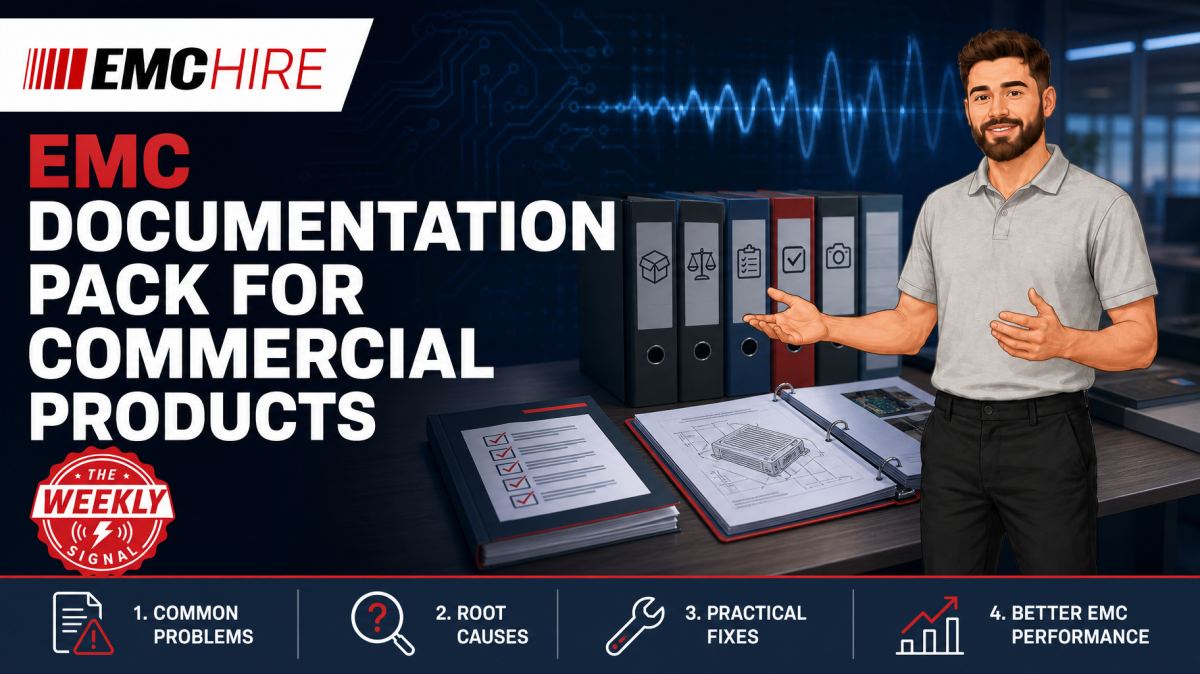
A product can pass its EMC tests and still reach market review with an evidence pack that is incomplete, inconsistent or impossible to reproduce.
The underlying problem is rarely a missing PDF. It is usually a broken chain between the product that was assessed, the configuration that was tested, the standards selected and the declaration ultimately signed.
What an EMC documentation pack needs to prove
An EMC documentation pack should allow a technically competent reviewer to understand what product was assessed, why the selected requirements were applicable, how testing was performed and whether the evidence represents the product being placed on the market.
The pack will commonly sit within the wider technical file for CE or UKCA marking. It may also support customer approvals, internal design assurance, tender submissions, product audits and investigations after a field complaint. The exact legal and contractual requirements depend on the product, intended market and conformity assessment route.
Testing alone does not complete every conformity obligation. The manufacturer or responsible economic operator remains responsible for identifying the applicable legislation, standards, test levels, limits, documentation requirements and route to conformity. Current official guidance should be checked, including relevant GOV.UK guidance on UKCA marking and the requirements for each intended market.
EMC documentation pack checklist
A useful pack is structured around evidence, not around whichever file names happened to arrive from the laboratory. The following document groups provide a workable starting point.
Product identity and controlled configuration
Start by defining the product precisely. Record the model number, hardware revision, firmware or software version, populated options, power supply, accessories and representative peripheral equipment. Photographs should show the enclosure, internal construction where appropriate, external ports, cable routing and identification labels.
This information prevents a common failure of traceability. If the test report refers to “prototype unit” while production records identify three hardware revisions and two power supply options, a reviewer cannot confidently connect the result to the released product.
- Product name, model and part numbers
- Hardware, PCB, firmware and software revisions
- Permitted options and variants
- External power supplies, cables and accessories
- Intended use and expected electromagnetic environment
- Production label and marking artwork
- Representative internal and external photographs
Applicable legislation, standards and assessment rationale
Document which regulatory requirements apply and why. For EMC, this may involve the relevant UK or EU legislation, but radio, electrical safety, machinery or sector-specific requirements may also affect the assessment. Product-specific or product-family standards should normally be considered before generic standards because they may define port applicability, operating modes, emissions limits, immunity requirements and performance criteria.
The standards list needs edition numbers and amendment status. Writing only “CISPR 32” or “EN 61000” is not enough. The latter is a broad standards family rather than a complete test specification.
Where harmonised or designated standards are not used in full, record the engineering rationale, gap analysis and alternative evidence. This may include an EMC risk assessment addressing the RF environment in which the equipment is intended to operate. Check the latest active editions and confirm product scope using authoritative sources such as BSI standards information and IEC guidance on international standards. Do not treat a summary or historical project test plan as a substitute for the published standard.
Test plan and configuration record
The test plan connects the product requirements to the physical assessment. It should identify the ports to be tested, operating modes, performance criteria, test methods, planned levels, frequency ranges and acceptance limits. Include justifications for ports or functions considered not applicable.
Operating modes deserve close attention. A communications product tested while idle may generate far less RF activity than the same unit transferring data at maximum throughput. Equally, an immunity test performed without monitoring a safety-related output may fail to detect a transient malfunction.
Record cable types, lengths, terminations and routing. For conducted emissions, document the relevant power port, LISN arrangement and measurement receiver settings. For conducted RF immunity under IEC 61000-4-6 where called up by the applicable product standard, document the CDN or other permitted injection arrangement. A BCI probe must not be substituted simply because it is available. BCI belongs to applicable current-injection procedures used by particular automotive, military, aerospace or product-specific methods.
Test reports and supporting measurement data
A test report should identify the EUT, methods, equipment, configuration, operating states, results and any deviations from the agreed plan. Photographs and setup drawings are often as valuable as result tables because they show whether a later investigation is comparing like with like.
For emissions work, retain plots together with detector type, measurement bandwidth, transducer data, measurement distance where relevant and final maximised readings. Peak, quasi-peak and average detectors are not interchangeable. Likewise, the resolution bandwidth must match the applicable standard and frequency range rather than a convenient analyser default.
Immunity reports need applied levels, dwell or exposure details where applicable, modulation, coupling method, monitored functions, performance criteria and observed behaviour. Do not describe immunity levels using emissions quantities. Radiated electric-field immunity is expressed in V/m, while conducted disturbance voltage may be recorded in dBµV.
Equipment schedules and calibration status should be retained. EMC Hire uses test equipment with calibration traceable through an appropriate ISO/IEC 17025 accredited calibration provider. Suitable traceable calibration supports repeatability, comparison between development and formal testing, and confidence in the recorded engineering data. Accreditation applies to the relevant calibration provider or activity, not to the physical instrument itself.
Design evidence, risk assessment and corrective actions
Include schematics, PCB information, grounding strategy, filtering details, enclosure bonding arrangements and cable interface protection where these support the assessment. Full manufacturing data may be held elsewhere under document control, but the technical file should make its location and revision clear.
Failures and corrective actions should not disappear from the record. Retain investigation notes, modifications, retest evidence and the engineering decision that closed the issue. A ferrite added during testing without a controlled part number, impedance characteristic or assembly instruction is not a production-ready mitigation.
Accessible EMC pre-compliance testing can help teams investigate such problems before a formal programme. It can provide calibrated engineering data and reduce late-stage redesign risk, but pre-compliance results do not automatically prove conformity.
Declarations and release approval
The Declaration of Conformity should identify the product, responsible entity, applicable legislation and standards, with an authorised signature and date. Its product description and revision status must agree with the technical file and test report.
Declarations should be generated from a controlled source rather than copied from an unrelated product. A declaration listing standards that were never assessed, obsolete company details or a different model family weakens the evidence trail and may create avoidable questions during review.
EMC Hire's guidance on CE marking requirements and commercial CE marking support provides further context. Manufacturers should still confirm the current legal requirements for every target market and retain responsibility for the signed declaration.
Document control after product release
An EMC documentation pack is not static. Component substitutions, PCB revisions, alternative power supplies, firmware changes and enclosure modifications can alter emissions or immunity behaviour. A switching regulator replacement may preserve functional performance while changing the spectral content of the power network enough to invalidate earlier assumptions.
Use a change process that asks whether the modification affects clock frequencies, edge rates, cable interfaces, filtering, shielding, grounding, power conversion or operating modes. Record the assessment even when no retest is considered necessary. That decision is part of the evidence.
Maintain a document index with revision, owner, approval status and storage location. Preserve raw and processed data in durable formats, not solely in proprietary instrument files. Access control matters, but so does retrieval. An archive that nobody can reconstruct five years later offers little practical protection.
Typical scenario
Consider an illustrative industrial controller with Ethernet, analogue sensor inputs, a 24 V DC supply and an optional external mains adaptor. Development testing used one PCB revision and a screened Ethernet cable, while production intends to offer two adaptors and permits an unscreened cable.
The compliance team first needs to define which arrangement represents the worst credible configuration. It must then identify the applicable product or product-family standard, relevant ports, operating modes and environmental assumptions. Conducted emissions on a relevant power port may require a LISN, while radiated emissions require suitable antennas and a controlled measurement setup. Immunity testing uses different equipment and methods.
Selecting the quietest adaptor or an unrepresentative idle mode could produce reassuring but weak evidence. Early investigation allows the team to compare adaptor noise, exercise communications traffic and check cable-related radiation before freezing the bill of materials.
EMC Hire can support equipment selection, pre-compliance engineering, on-site testing, access to test facilities and formal compliance testing where appropriate. The resulting records can then be organised into a coherent technical file supporting self-certification where legally and technically applicable. Some sectors or contracts, including defence, automotive and aerospace programmes, may require final work from an appropriately accredited laboratory.
When to Hire EMC Equipment
Hiring is often sensible when test demand is short-term, irregular or tied to a specific design phase. It avoids capital expenditure on receivers, LISNs, antennas, CDNs, amplifiers or transient generators that may not suit the next product programme.
The technical case matters more than the accounting case. Equipment must cover the required frequency range, power, test level and coupling method. Its accessories, calibration status and software also need to support the intended procedure. Buying an analyser without the required detectors, preselection or transducer correction capability can leave a team with an expensive instrument that cannot produce defensible results.
Rental can cover project peaks without adding long-term storage, servicing and calibration overheads. It also allows engineers to obtain the correct equipment for a defined test window. EMC Hire can help review the intended method and configuration before dispatch, reducing the chance of hiring a CDN for a BCI procedure or using a general-purpose spectrum analyser where a compliant measurement receiver function is required.
Common EMC Testing Mistakes to Avoid
Testing an unidentified configuration
Reports that omit hardware, firmware, accessories or cable details cannot reliably represent production. Record the exact EUT configuration before testing begins, not from memory afterwards.
Using the wrong operating mode
An idle or diagnostic mode may suppress clocks, converters or communications traffic. The resulting emissions scan can create false confidence, while immunity monitoring may miss functional degradation that occurs only under load.
Confusing development scans with formal evidence
Near-field probes and peak detector sweeps are excellent diagnostic tools, but they are not direct substitutes for the prescribed final measurement. Label pre-compliance data clearly and explain how it informed later testing.
Losing setup traceability
Unrecorded cable positions, ground-plane arrangements and bonding details make retesting difficult. At higher frequencies, small changes in cable geometry can materially alter coupling and radiated results.
Copying incorrect receiver settings
Applying one resolution bandwidth or detector across every frequency range can produce invalid measurements. Use the settings required by the applicable standard and retain them in the report or raw data.
Failing to reconcile the final documents
A test report, product label and declaration carrying different model numbers or standard editions break the evidence chain. Perform a final cross-document review before release.
Frequently Asked Questions (FAQs)
Does a passing test report complete the EMC technical file?
No. The file normally needs product identification, applicable requirements, design and risk evidence, test configuration, reports, corrective actions and the relevant declarations. Other legislation may require further documentation.
Can pre-compliance results be included?
Yes, provided they are clearly identified and their limitations are understood. They can show design development, mitigation decisions and calibrated engineering evidence, but they do not automatically replace testing required by the selected conformity route.
Should raw measurement data be retained?
Retaining plots, tables, settings, correction factors and setup photographs improves traceability. Raw data is particularly useful when a limit changes, a configuration is questioned or a later product revision needs comparison.
How should product variants be handled?
Define the technical differences and assess whether one configuration genuinely represents the others. Where a family approach is used, document the worst-case rationale and any supporting tests. Commercial similarity alone is not an EMC justification.
How long should the documentation be kept?
Retention periods depend on the applicable legislation and market. Confirm the current requirement for each product and jurisdiction, then ensure company systems preserve readable, controlled records for at least that period.
Where can engineers find further test guidance?
EMC Hire's EMC test guides cover practical methods and equipment considerations. Always verify the latest active standard, limits, test levels, configurations and customer-specific requirements before fixing the test plan.
Building a defensible evidence trail
A strong EMC documentation pack is one in which every conclusion can be traced back to a controlled product configuration and an appropriate piece of engineering evidence. That discipline makes formal testing more efficient, supports declarations and gives internal stakeholders a clearer basis for release decisions.
To discuss equipment hire, pre-compliance work, formal compliance testing, on-site testing or a booking at the EMC Hire test facility, contact the engineering team on +44 (0)1462 817111 or email sales@emchire.co.uk. A review of the product, intended market and proposed test plan is usually the best place to start.
Disclaimer: Content is for informational purposes only and does not constitute formal engineering or regulatory advice. Always verify testing procedures against current official standards (e.g., ISO, MIL-STD, DEF STAN). EMC Hire Limited accepts no liability for outcomes resulting from the use of this information.