

EMC pre-compliance for product launches
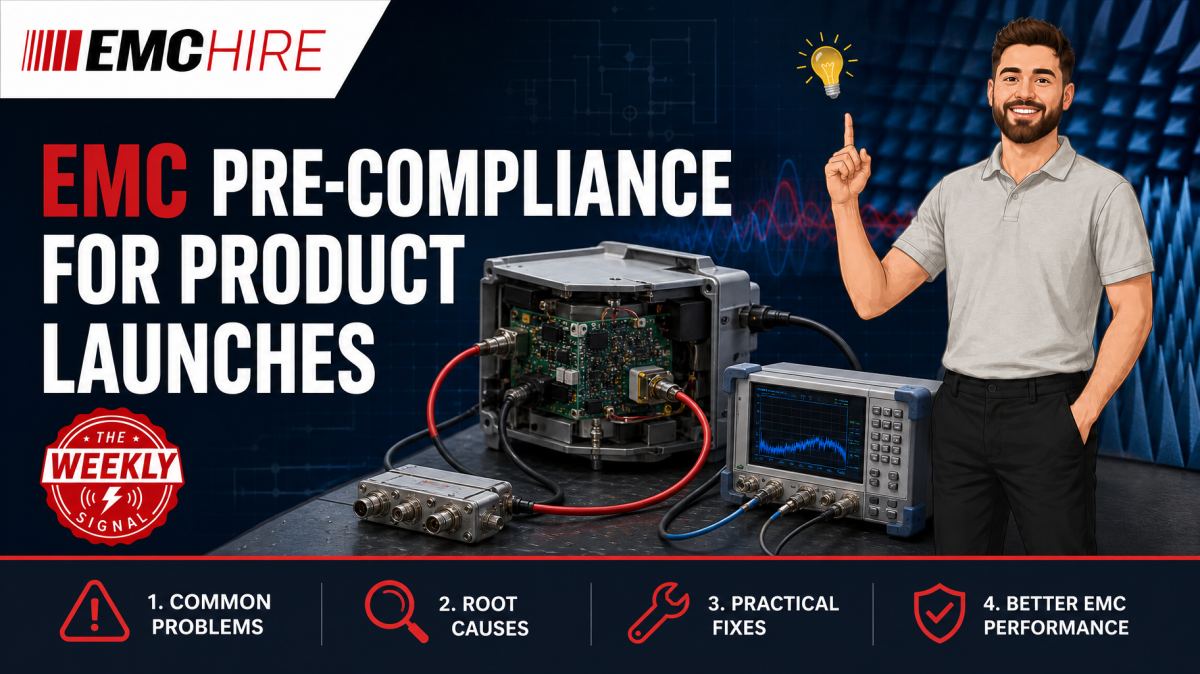
A product can be functionally complete and still miss its launch because one cable radiates, one power port exceeds a conducted limit, or one immunity event resets the controller.
An effective EMC pre-compliance launch plan finds those weaknesses while the engineering team still has time, budget and access to the design.
Why EMC failures disrupt launch schedules
EMC problems rarely remain confined to the test laboratory. A failed emissions or immunity test can affect enclosure tooling, printed circuit board layout, cable assemblies, firmware, power supplies, labelling and technical documentation. The technical fix may be straightforward. Releasing that fix through design control, procurement and manufacturing is often the slower part.
Product managers should therefore treat EMC as a schedule dependency rather than a final verification task. Waiting until the production-intent unit is booked for formal testing removes many of the cheapest corrective options. PCB changes may require another fabrication cycle. A revised cable shield can trigger supplier lead times. Adding a filter after safety testing may require further assessment because leakage current, insulation or thermal behaviour has changed.
Pre-compliance testing does not prove that a product complies. It provides engineering evidence about likely failure modes, margins and configuration sensitivity before the formal programme. Used properly, it turns an uncertain late-stage event into a series of controlled technical decisions.
Build the test plan around the product, not a generic checklist
The starting point is the product scope. Identify intended markets, user environment, power interfaces, wired ports, radio functions, cable lengths, operating modes and accessories. From there, determine the applicable legislation and the relevant product or product-family standards. Generic EMC standards may be appropriate where no more specific standard exists, but that decision needs to be justified.
IEC basic immunity methods, such as the IEC 61000-4-x series, describe test techniques. They do not by themselves define every product requirement or emissions limit. Product and product-family standards may specify port applicability, performance criteria, test levels, operating configurations and emissions limits. CISPR publications underpin many emissions requirements, but the applicable document depends on the equipment category and intended environment.
Before committing laboratory time, the test plan should record:
- the product variants and representative configuration;
- the intended operating environment and markets;
- all mains, DC, signal, telecommunications and enclosure ports;
- the applicable product or product-family standards;
- operating modes likely to maximise emissions or susceptibility;
- cable types, lengths, terminations and peripheral equipment;
- performance criteria and methods for detecting degradation;
- software, firmware and hardware revision identifiers;
- the tests to be screened during development and repeated formally.
Always verify the latest active edition of each relevant standard, together with its scope, limits, frequency ranges, test levels, equipment configuration and documentation requirements. Contractual specifications may impose further conditions, particularly in defence, automotive and aerospace programmes.
Place EMC checks at points where fixes remain affordable
A single pre-compliance session immediately before formal testing is better than no investigation, but it leaves limited recovery time. A stronger schedule uses several targeted checkpoints.
Architecture and schematic review
Early review should examine switching frequencies, clock distribution, interface filtering, grounding strategy, isolation boundaries, cable shield termination and expected current return paths. No measurement can fully validate an unbuilt product, yet this review can expose decisions that would otherwise become embedded in PCB layout or mechanical tooling.
First functioning engineering prototype
Once the prototype can exercise representative loads and communications, near-field probing and conducted measurements can identify dominant noise sources. Current probes can help determine whether common-mode current is flowing on external cables. These observations guide fixes before the enclosure and harness become fixed.
Production-intent configuration
Later testing should resemble the intended formal setup: correct enclosure, production power supply, specified cables, realistic peripherals and release-candidate firmware. Measurements made on an open development board can support diagnosis, but they cannot reliably predict the behaviour of the finished assembly.
Leave time between each checkpoint for diagnosis, component sourcing, PCB modification and regression testing. A schedule that allocates one day for testing but no time for fixes is not an EMC plan. It is a pass-or-delay gamble.
Measure the failure mechanism, not just the limit line
For conducted emissions on relevant power ports, a suitable LISN provides a defined impedance and measurement connection. Measurements are commonly required from 150 kHz to 30 MHz, although the applicable standard must determine the actual range, detector and receiver settings. Peak scans can locate disturbances efficiently, while quasi-peak and average measurements may be needed where specified. A spectrum analyser display using arbitrary bandwidth and detector settings cannot be treated as equivalent to a compliant receiver measurement.
Radiated emissions commonly begin at 30 MHz, but the upper frequency, antenna arrangement, measurement distance and site requirements depend on the product and applicable standard. Cable placement can alter common-mode radiation substantially. Moving a cable to obtain a better result without documenting the position creates false confidence and makes the measurement difficult to reproduce.
Immunity needs separate planning. A CDN may be used for conducted RF immunity where the applicable IEC 61000-4-6-based method calls for it. A BCI probe belongs to applicable current-injection procedures used in automotive, military, aerospace or other product-specific methods. The two are not interchangeable simply because both couple RF onto cables.
Performance monitoring matters as much as the applied disturbance. A brief communication error, analogue drift or watchdog reset may be missed if the operator only checks whether the display remains illuminated. Define observable pass criteria and capture diagnostic logs before testing starts.
Turn test results into launch decisions
A useful pre-compliance report distinguishes confirmed failures, low-margin results, configuration-sensitive behaviour and tests not yet investigated. Product managers can then assign owners and dates rather than receiving a vague statement that the prototype was “mostly fine”.
Record plots, detector settings, bandwidths, transducer factors, equipment identifiers, calibration status, photographs, cable positions, EUT modes and environmental conditions. EMC Hire uses test equipment with calibration traceable through an appropriate ISO/IEC 17025 accredited calibration provider. Suitable traceable calibration supports measurement accuracy, repeatability and comparison between development and formal testing. It also strengthens the evidence available to engineering teams, corporate stakeholders and reviewers.
Formal compliance testing contributes to the technical file, EMC risk assessment, mitigation evidence and Declaration of Conformity where applicable. Testing alone does not complete every conformity obligation. The manufacturer or responsible economic operator remains responsible for confirming the applicable legislation, standards, conformity assessment route and documentation requirements. The CE marking guidance and information on commercial product CE marking provide further context for product teams.
Typical scenario
Consider an illustrative industrial controller scheduled for launch in twelve weeks. It contains a switch-mode power supply, Ethernet, several metres of sensor cabling and a plastic enclosure with a conductive internal coating. Functional verification is nearly complete, but no representative EMC measurements have been made.
The engineering team first needs to identify the applicable product requirements and build a configuration matrix. Maximum processor activity may produce the highest radiated emissions, while simultaneous sensor operation and network traffic may be the most sensitive immunity mode. The longest specified external cables should be considered because they can provide efficient common-mode coupling paths.
An initial pre-compliance session could include conducted emissions screening through a suitable LISN, radiated emissions investigation with appropriate antennas and site arrangements, and selected immunity checks based on the applicable product standard. Diagnostic current and near-field probes may then help separate a noisy source from the coupling path.
Suppose screening indicates elevated common-mode current on the sensor cable. Blindly adding ferrites could suppress one configuration while leaving shield termination or PCB return-path problems unresolved. Investigation might instead compare shield bonding, connector construction, filter placement and cable routing. The aim is not merely to lower one trace. It is to identify a fix that survives production tolerances and realistic installation conditions.
Early investigation leaves time for a revised connector bond or PCB filter footprint. Finding the same issue during the final test window could force a launch delay, an unplanned hardware revision or a narrowly validated retrofit.
EMC Hire can support the project through EMC pre-compliance testing, equipment hire, test facility access, on-site investigation and formal compliance testing where appropriate. Hiring diagnostic or measurement equipment for the defined development window can avoid capital expenditure and the calibration, storage and servicing burden associated with equipment that may only be needed during project peaks.
When to Hire EMC Equipment
Hiring is well suited to short development phases, intermittent verification work and fault investigations where the required instrument may change as the mechanism becomes clearer. A team investigating cable radiation might need a current probe and analyser first, then a LISN and measurement receiver for power-port emissions. Buying a fixed package before the test plan is mature can leave the business owning equipment that is unsuitable for later programmes.
Rental also allows internal teams to test around firmware releases and hardware spins instead of competing for a narrow external laboratory slot. This can reduce diagnostic delay, provided the test environment and method are understood. Bench testing in an uncontrolled RF environment should not be presented as equivalent to a formal radiated emissions measurement.
For defined project windows, hiring can provide:
- access to test equipment matched to the relevant method and frequency range;
- additional capability during overlapping development programmes;
- freedom from long-term storage, maintenance and calibration overheads;
- a lower risk of purchasing equipment that cannot support future products;
- time for repeated investigations before a formal laboratory booking.
Where the team lacks a suitable site, experienced operators or a stable setup, booking a test facility or arranging on-site support may provide better data than instrument hire alone. EMC Hire can help select a proportionate route based on the product, schedule and evidence required.
Common EMC Testing Mistakes to Avoid
Testing an unrepresentative operating mode
An idle processor, disconnected load or disabled communications interface may produce an attractive emissions plot that says little about the released product. Define modes that exercise clocks, converters, motors, displays and data ports, then record exactly how each mode was established.
Changing cable positions without recording them
External cables often dominate radiated behaviour. Undocumented routing changes can move a result by enough to hide a marginal design, while preventing another engineer from reproducing the setup.
Using a LISN incorrectly
A LISN is used for conducted emissions measurements on relevant power ports. Incorrect port connection, poor bonding, missing termination or operation outside the network's rating can invalidate the result and may create a safety risk. It must not be treated as a conducted immunity coupling device.
Applying the wrong detector or bandwidth
Peak, quasi-peak and average detectors serve different measurement purposes under CISPR-based methods. Likewise, the specified resolution bandwidth depends on the frequency range and applicable standard. Arbitrary analyser settings can produce readings that cannot be compared meaningfully with the limit.
Ignoring ambient signals
Broadcast, mobile and local digital transmissions can appear in radiated scans. Without ambient checks or controlled-site investigation, the team may waste time redesigning around an external signal or overlook EUT emissions hidden beneath it.
Keeping incomplete records
A plot without equipment configuration, calibration status, correction factors, cable layout, operating mode and product revision is weak engineering evidence. Months later, the team may be unable to show whether a changed result came from the product, setup or instrument chain. The EMC test guides provide further practical planning information.
Frequently Asked Questions (FAQs)
How early should EMC pre-compliance begin?
Start with design review during architecture and schematic development, then measure as soon as representative hardware can operate. Waiting for a production-complete unit removes many low-cost PCB, filtering and mechanical fixes.
How much margin should a pre-compliance result have?
There is no universal margin. Site correlation, measurement uncertainty, product variation, cable configuration and operating mode all matter. A result just below a limit should be treated as a launch risk until those factors are understood.
Can pre-compliance data support CE or UKCA self-certification?
Calibrated, well-documented engineering data may support the technical file and self-certification reasoning where that route is legally and technically appropriate. It does not automatically demonstrate conformity. The manufacturer must confirm the applicable legislation, standards and assessment route.
Should every formal test be repeated during pre-compliance?
Not always. Prioritise high-risk interfaces, new circuitry, configuration-sensitive tests and failure modes with long redesign lead times. The formal test plan should still cover all applicable requirements.
When is on-site testing preferable?
On-site work can be useful for large, fixed or operationally complex equipment that cannot be represented easily in a laboratory. Ambient conditions, available ground planes, cable installation and safety controls must be assessed before deciding what evidence the setup can produce.
Does formal testing guarantee market access?
No. Robust testing can support a defensible compliance evidence trail, but market access also depends on product scope, legislation, documentation, labelling and other applicable obligations. Some sectors or contracts may require an appropriately accredited laboratory.
Plan the next test window
If an upcoming launch has unresolved EMC risks, EMC Hire's engineering team can help review the test plan, select suitable hire equipment, arrange on-site testing, book space at the EMC Hire test facility, or discuss pre-compliance and formal compliance testing.
Call +44 (0)1462 817111 or email sales@emchire.co.uk with the product type, intended markets, target standards, interfaces and launch schedule. That information allows the test approach to be scoped around the engineering risk rather than a generic equipment list.
Disclaimer: Content is for informational purposes only and does not constitute formal engineering or regulatory advice. Always verify testing procedures against current official standards (e.g., ISO, MIL-STD, DEF STAN). EMC Hire Limited accepts no liability for outcomes resulting from the use of this information.