


Common EMC questions from medical startups
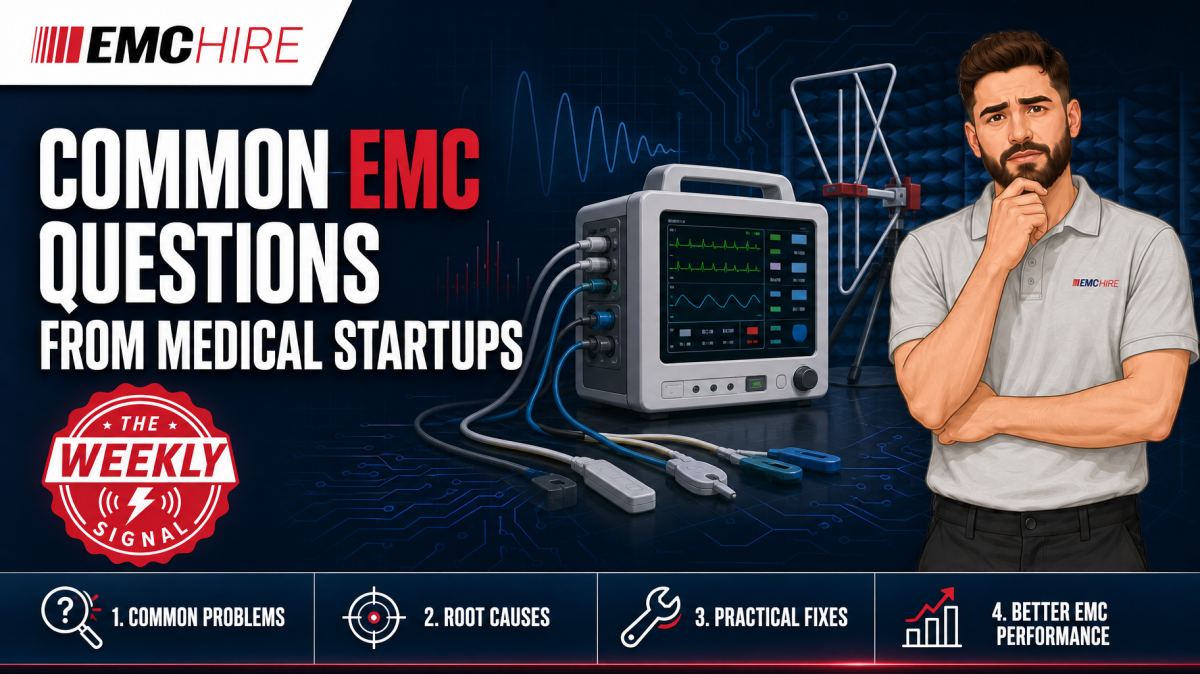
A medical device can pass emissions testing and still be unsafe or commercially unready because its immunity performance was assessed in the wrong operating mode.
That distinction catches out small teams. Medical EMC is not simply a matter of producing a quiet circuit board. The device must limit electromagnetic disturbances while continuing to provide its intended functions, including defined performance related to safety, when exposed to relevant electromagnetic phenomena.
Why medical EMC planning starts before the laboratory
Most early medical EMC questions concern timing, cost and which standard to use. The better starting point is the device itself: intended use, intended environment, applied parts, power architecture, interfaces, accessories, radio functions and the consequences of degraded performance.
IEC 60601-1-2 is widely associated with electromagnetic disturbances for medical electrical equipment and systems. Its applicability, edition and national adoption must be checked against the product scope and target market. Some products fall under different or additional standards. In vitro diagnostic equipment, for example, may require a different product-family route. A wireless function can introduce radio regulatory requirements alongside medical device obligations.
Do not treat a basic immunity method such as IEC 61000-4-2 for electrostatic discharge as the product standard. Basic IEC 61000-4-x methods describe how particular immunity tests are performed. The applicable medical product standard or agreed test plan determines which phenomena, levels, ports, configurations and performance criteria apply.
Teams should verify the latest active editions, amendments, national adoptions, test levels, frequency ranges, operating configurations and documentation requirements. The GOV.UK guidance on medical device conformity assessment and UKCA marking, together with current BSI and IEC information, provides useful source material. It does not replace product-specific regulatory advice.
Which EMC tests are normally considered?
The test programme depends on classification, construction, ports, intended environment and applicable standards. Medical electrical equipment commonly needs assessment for both emissions and immunity. These are separate engineering questions.
Conducted emissions measurements on relevant power ports use a suitable LISN and measuring receiver. Depending on the applicable requirements, measurements are commonly encountered between 150 kHz and 30 MHz, but that range must not be assumed without checking the standard. Peak scanning can speed investigation, while quasi-peak and average detectors may be required for final comparison with particular limits. Receiver bandwidth and detector selection must follow the relevant method.
Radiated emissions use antennas at a controlled distance in a characterised test environment. Testing commonly starts at 30 MHz, although the upper frequency, antenna type, detector and measurement distance depend on the product and applicable requirements. Moving a cable by 100 mm can materially change common-mode radiation. Cable positions therefore belong in the setup record, not in the engineer's memory.
Immunity may include electrostatic discharge, radiated RF fields, electrical fast transient or burst, surge, conducted RF, power-frequency magnetic fields, and voltage dips or interruptions. A CDN may be used for conducted RF immunity under IEC 61000-4-6 where the port and method permit it. It is not a substitute for a LISN, and neither device should be selected simply because it fits the connector.
Medical devices also require meaningful performance monitoring. A display remaining illuminated does not prove that the device maintained acceptable operation. Sensor accuracy, alarm behaviour, therapy delivery, data integrity, communications and recovery may all need observation against predefined acceptance criteria.
Typical scenario
Consider an illustrative startup developing a mains-powered patient monitor with an external sensor, Ethernet, USB service access and an internal wireless module. The prototype works on the bench, but the team has not yet frozen its enclosure, cable set or power supply.
The likely programme includes conducted and radiated emissions plus applicable immunity tests selected from the governing medical standard and risk analysis. The team must decide which accessories represent the marketed configuration, whether every port can be exercised, what constitutes unacceptable degradation and how clinical functions will be monitored during exposure.
Using a convenient laboratory power supply instead of the intended external PSU could conceal conducted emissions from the production unit. Testing only an idle screen may miss RF susceptibility in the high-gain sensor path. Removing Ethernet because it creates failures does not resolve the problem if Ethernet remains a supported user configuration.
An early medical device EMC compliance review can expose these gaps while changes are still manageable. Pre-compliance emissions scans, current-probe investigation and selected immunity testing can identify coupling paths before tooling or regulatory submissions make redesign expensive. Such work provides engineering evidence and improves readiness, but it does not automatically prove compliance.
EMC Hire can support equipment selection, test setup, accessible pre-compliance work, on-site investigation, facility bookings and formal compliance testing where appropriate. Equipment hire can also cover a concentrated debugging window without committing a startup to receivers, LISNs, probes or generators that may not suit its next programme.
How early should a startup begin pre-compliance work?
Start once the architecture is representative enough to reveal real coupling paths, but before mechanical and PCB changes become commercially painful. That often means testing an electrically functional prototype with representative power conversion, enclosure bonding, cable types and I/O activity.
Very early scans on a bare PCB can still locate clock harmonics and switch-mode noise. Their limitation is representativeness. Final emissions often depend on enclosure seams, cable shields, power supplies and common-mode current paths that do not exist on the bare assembly.
A staged approach usually gives better information:
- Review the intended environment, ports, accessories and operating modes.
- Perform near-field and current-probe debugging during board development.
- Run representative conducted and radiated emissions pre-scans.
- Apply selected immunity phenomena while monitoring safety-related functions.
- Freeze the test configuration and enter formal testing with controlled hardware and software.
EMC Hire uses test equipment with calibration traceable through an appropriate ISO/IEC 17025 accredited calibration provider where calibration is relevant to the measurement. Suitable traceable calibration supports repeatability, comparison between development and formal results, and a stronger evidence trail. It does not make an incomplete setup representative.
What evidence is needed for CE or UKCA?
Testing is one part of the conformity process. The manufacturer or responsible economic operator must establish the applicable legislation, standards, conformity assessment route and documentation requirements for each market.
Robust EMC records may support the technical file, electromagnetic risk assessment, mitigation evidence, Declaration of Conformity and discussions with stakeholders or conformity assessment organisations. Useful records include hardware and software versions, photographs, cable layouts, support equipment, operating modes, performance criteria, deviations, raw data and calibration status.
The routes for CE marking and UKCA should not be treated as interchangeable paperwork exercises. Medical device requirements, transition arrangements and involvement of third-party conformity assessment bodies can change. Review current official guidance before committing to a market-entry plan. EMC testing alone does not complete every CE or UKCA obligation.
For broader context, EMC Hire's guidance on commercial CE marking explains the role of compliance evidence in non-medical product programmes. Medical products still require their own sector-specific assessment rather than a generic commercial route.
When to Hire EMC Equipment
Hiring is technically sensible when the requirement is short-lived, the project needs specialist equipment, or the team needs parallel debugging capacity before a laboratory booking. A startup might hire a measuring receiver, suitable LISN, current probe or near-field probes for a defined emissions investigation, provided it has the competence and test environment to interpret the data.
Immunity equipment requires more care. RF generators, amplifiers, CDNs, coupling clamps and transient generators must match the method, level, frequency range, port and safety constraints. Hiring the wrong CDN impedance or an amplifier with inadequate linear output can create an apparently polished but invalid test.
Rental avoids unnecessary capital expenditure and reduces storage, servicing and calibration overheads. It also limits the risk of purchasing equipment that becomes unsuitable when the next product uses different ports, frequencies or standards. During project peaks, hiring can expand internal capability without building a permanent laboratory around irregular demand.
Ownership is not always the lower-risk choice. Equipment that sits unused may drift out of calibration, lose accessories or become obsolete. If the team lacks a controlled site, experienced operators or suitable monitoring, booking an EMC facility or arranging on-site support may produce more defensible data than hiring instruments alone.
Common EMC Testing Mistakes to Avoid
Testing a convenient operating mode
An idle device may generate fewer emissions and exercise fewer susceptible analogue paths than the intended clinical mode. If pumps, alarms, radios, heaters or sensor channels are not active, both emissions and immunity results can create false confidence.
Changing cable layout without recording it
Cables act as coupling structures and antennas. Unrecorded changes to length, routing, shield termination or excess-cable arrangement undermine repeatability and can prevent a formal laboratory from reproducing an earlier result.
Confusing a ground connection with good bonding
A long wire to a ground plane adds inductance. At high frequency it may provide little effective bonding, changing common-mode currents and ESD return paths. Bonding methods should represent the intended installation rather than an improvised bench arrangement.
Using the wrong coupling network
A LISN supports conducted emissions measurement on relevant power ports. A CDN supports conducted RF immunity where the applicable method permits it. Substituting one for the other changes the impedance and coupling path, invalidating the engineering conclusion.
Monitoring only for resets
A device can remain powered while producing corrupted measurements, delayed alarms or inaccurate output. Immunity acceptance criteria must cover the functions tied to safety and intended performance, including allowable degradation and recovery behaviour.
Keeping incomplete test records
A pass statement without photographs, configurations, software versions, detector settings and accessory details is difficult to defend. Weak documentation also wastes debugging time because engineers cannot tell whether a later difference came from the product or the setup.
Frequently Asked Questions (FAQs)
Does a medical device have to pass IEC 60601-1-2?
Not automatically in every case. Applicability depends on whether the product falls within the standard's scope, the target market, device type and conformity strategy. Confirm the current edition and national adoption, then check for more specific product standards and regulatory expectations.
Can pre-compliance data be used in our technical file?
Calibrated, well-documented pre-compliance data can support design decisions, risk management and mitigation evidence. Its weight depends on test quality, representativeness and the applicable conformity route. It should not be described as formal proof when the setup or method differs materially from the required test.
Should we test every accessory and cable?
The selected configurations should cover reasonably foreseeable and worst-case marketed arrangements. That does not always mean testing every permutation. A documented rationale should consider cable length, shielding, port activity, power source and accessory electronics. Unsupported accessories should not quietly appear in user documentation after testing.
What happens if the device contains Wi-Fi or Bluetooth?
The radio introduces additional regulatory and coexistence considerations. The team must assess the applicable radio requirements, antenna configuration and simultaneous operating modes. Radio transmission can also affect EMC monitoring and may expose internal susceptibility that is absent when the transmitter is disabled.
Can we perform medical EMC testing on our own premises?
Some debugging and selected pre-compliance work can be performed on-site if the environment, safety controls and equipment are suitable. Ambient RF, uncontrolled reflections and inadequate ground references can limit radiated results. Formal testing may be better placed in a controlled facility, and some programmes may require an appropriately accredited laboratory.
How do we define a pass during immunity testing?
Define observable, technically justified performance criteria before testing. They should follow the applicable product requirements and risk analysis, covering safety-related functions, permissible degradation, operator intervention and recovery. A generic statement such as "device continued to operate" is usually too weak for a complex medical product.
Planning the next test stage
Medical startups rarely need every piece of EMC equipment. They need the right method, representative hardware and a test plan that produces evidence the next reviewer can understand.
EMC Hire supports medical device EMC programmes through equipment hire, pre-compliance engineering, facility access, on-site testing and formal compliance testing where appropriate. The team can help identify suitable equipment, review configurations and plan a practical route from prototype investigation to controlled testing.
To discuss medical EMC questions, request an equipment hire quotation, arrange on-site support or book space at the EMC Hire test facility, call +44 (0)1462 817111 or email sales@emchire.co.uk.
Disclaimer: Content is for informational purposes only and does not constitute formal engineering or regulatory advice. Always verify testing procedures against current official standards (e.g., ISO, MIL-STD, DEF STAN). EMC Hire Limited accepts no liability for outcomes resulting from the use of this information.